 English
 中文简体
 русский
 Français
 Español
 عربى
 Indonesia

Outdoor Stadium Flood Light HS-LH: High-Intensity Illumination for Large-Scale Outdoor Applications
Outdoor lighting for stadiums, airports, logistics yards, and public squares must perform under demanding conditions. Large open areas require powerful illumination, consistent beam distribution, dependable operation, and mechanical strength. At the same time, facility owners need equipment that can withstand weather exposure, support different installation layouts, simplify maintenance, and deliver predictable lighting quality throughout its service life.
The Outdoor Stadium Flood Light HS-LH is a heavy-duty LED flood lighting solution developed for these requirements. It belongs to the Land Rover Series and is available in power configurations from 500W to 3000W. This broad range allows lighting designers, contractors, and project owners to select an appropriate output level for sports venues, industrial sites, transport facilities, municipal areas, and other large-scale outdoor projects.
Rather than serving as a general-purpose decorative luminaire, the HS-LH is designed around long-distance projection, high-intensity illumination, and stable operation. Its optical options include narrow and wide beam angles from 15 degrees to 120 degrees, allowing the fixture to be adapted to different mounting heights, target areas, and lighting plans. The product also supports switch control and PMX512 control, giving users flexibility in basic installations as well as more coordinated lighting systems.
Behind the product is Cixi HuaSheng Lighting Co., Ltd., an outdoor lighting manufacturer located in Ningbo, China. The company combines product development, die-casting, CNC machining, aging, testing, and customized lighting services. Its manufacturing capabilities support OEM and ODM projects, including beam angle customization, bracket design, housing color selection, mold development, and other project-specific requirements.
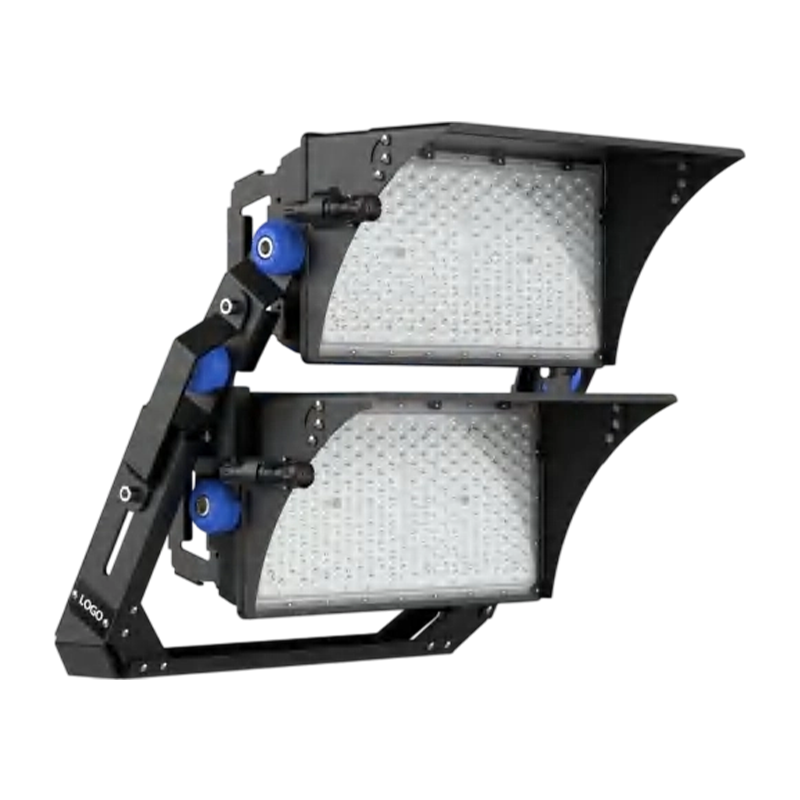
Outdoor Stadium Flood Light HS-LH
1. The Role of High-Power Flood Lighting in Modern Outdoor Projects
Outdoor environments are more difficult to illuminate than enclosed spaces. Light can be lost across long distances, affected by wind and weather, or distributed unevenly across large surfaces. Stadium seating, playing fields, industrial yards, airport operating areas, and public squares may contain different elevations, obstacles, safety zones, and viewing directions. A suitable floodlight must therefore provide more than high wattage alone.
The fixture must produce useful light at the required distance, maintain a suitable beam shape, and support accurate positioning. It must also remain mechanically stable after installation. In many projects, lighting is installed on high masts, building structures, towers, or large brackets. Access for maintenance can be difficult and expensive, so reliability and serviceability are important factors in the total cost of ownership.
The HS-LH addresses these requirements through a combination of high-power LED technology, multiple optical choices, robust construction, and control compatibility. The series includes 500W, 1000W, 1500W, 2000W, and 3000W models. This makes it possible to develop a consistent lighting strategy across different areas of one project. For example, a stadium may use higher-power versions for long-distance field illumination and lower-power versions for access roads, service areas, or adjacent public spaces.
High-power LED floodlights are also increasingly selected as replacements for older discharge or halogen systems. LED technology can provide directional light, rapid switching, digital control compatibility, and a compact optical system. When the fixture is properly engineered with thermal management and suitable housing materials, it can support long operating periods while maintaining a stable lighting output.
2. Product Overview and Main Specifications
The Outdoor Stadium Flood Light HS-LH is designed for outdoor applications requiring wide-area, high-intensity illumination and stable long-distance projection. The product uses a heavy-duty housing intended for exposure to demanding operating environments. Its design supports multiple installation and optical configurations, enabling the same product family to serve sports, industrial, transportation, municipal, and commercial projects.
| Item | Specification |
|---|---|
| Product name | Outdoor Stadium Flood Light HS-LH |
| Series | Land Rover Series |
| Application category | LED Stadium Light |
| Available power | 500W, 1000W, 1500W, 2000W, and 3000W |
| Input voltage | AC100V–250V, 50Hz; DC24V |
| Security classification | Class I / Class III |
| Driver | Brand-name power supply |
| Control modes | Switch control and PMX512 control |
| Optical options | 15°, 30°, 45°, 60°, 90°, and 120° |
The listed voltage range gives the product flexibility for different project power systems. The inclusion of AC100V–250V, 50Hz and DC24V options helps project teams evaluate the fixture for varied installation conditions. Electrical design should always be confirmed against the final project environment, driver configuration, local regulations, and installation requirements before ordering.
The use of a brand-name power supply is another important part of the system. In a high-power LED fixture, the driver affects start-up behavior, current stability, control compatibility, protection performance, and overall operating reliability. Selecting a suitable power supply helps the LED modules operate within their intended electrical range and supports consistent performance during extended use.
3. Power Options for Different Project Scales
A major advantage of the HS-LH series is its range of power options. Outdoor projects do not all have the same mounting height, target area, lighting level, or operating purpose. A single wattage would force users either to over-light smaller areas or use too many fixtures for larger areas. The 500W to 3000W range offers a more practical starting point for photometric planning.
500W Configuration
The 500W model is suitable for medium-scale outdoor areas, shorter projection distances, secondary stadium zones, access areas, and selected industrial applications. Its listed product weight is 11 kilograms, with product dimensions of 563 x 313 x 416 millimeters. The relatively compact form can be useful where installation space, support structure, or handling access must be considered.
1000W Configuration
The 1000W model provides a higher output level for larger areas and greater mounting heights. It weighs 27.3 kilograms and measures 665 x 603 x 574 millimeters. This configuration may be selected for larger field sections, logistics yards, airport service zones, or municipal areas requiring stronger illumination than a medium-power fixture can provide.
1500W Configuration
The 1500W model weighs 41 kilograms and has listed dimensions of 665 x 885 x 811 millimeters. This level is intended for demanding applications in which long-distance projection and broad area coverage are both important. It can be integrated into sports lighting schemes, large industrial compounds, and high-mast installations after a suitable photometric and structural assessment.
2000W Configuration
The 2000W model is designed for very large outdoor spaces and high-output applications. Its listed weight is 54.6 kilograms, with product dimensions of 1166 x 603 x 573 millimeters. Because of its power and physical size, installation planning should include structural support, lifting arrangements, wind loading, cable routing, and maintenance access.
3000W Configuration
The 3000W model is the highest listed configuration in the series. It weighs 82 kilograms and has listed product dimensions of 1166 x 603 x 573 millimeters. This model can be considered for major stadiums, large yards, high-mast lighting systems, and other applications requiring very high output. Due to its weight and electrical rating, professional installation and detailed project engineering are essential.
| Power | Weight | Product dimensions | Package dimensions |
|---|---|---|---|
| 500W | 11 kg | 563 x 313 x 416 mm | 595 x 390 x 260 mm |
| 1000W | 27.3 kg | 665 x 603 x 574 mm | 720 x 720 x 260 mm |
| 1500W | 41 kg | 665 x 885 x 811 mm | 1060 x 720 x 260 mm |
| 2000W | 54.6 kg | 1166 x 603 x 573 mm | 1185 x 720 x 260 mm |
| 3000W | 82 kg | 1166 x 603 x 573 mm | 1185 x 720 x 260 mm |
The product dimensions and weights should be reviewed at the design stage rather than after the mounting system has been selected. A high-power floodlight is part of a complete installation that includes poles, brackets, anchor systems, cables, control equipment, and maintenance provisions. The manufacturer can support project teams with bracket design and other OEM or ODM requirements when a standard configuration does not fully match the installation structure.
4. Optical Flexibility from 15 Degrees to 120 Degrees
Beam angle is one of the most important factors in outdoor floodlight selection. A narrow beam can project light farther and concentrate illumination on a particular area. A wider beam can distribute light across a larger zone and help reduce the number of fixtures required for broad spaces. The correct choice depends on mounting height, distance to the target area, desired uniformity, glare considerations, and the shape of the site.
The HS-LH series provides 15°, 30°, 45°, 60°, 90°, and 120° lens angle options. This range supports both focused and wide-area lighting strategies. A 15° beam may be considered for long-distance projection or targeted illumination. A 30° or 45° beam can support intermediate distances and defined zones. Wider 60°, 90°, and 120° options can be considered for open areas where broad coverage is required.
In a stadium, different beam angles may be used at different mounting locations. Floodlights installed farther from the playing area may need tighter optics, while fixtures positioned closer to peripheral zones may use wider optics. The goal is not simply to select the widest or narrowest beam; it is to coordinate the optical distribution with the geometry of the venue and the required lighting performance.
For logistics yards and public squares, wide beam options may help cover open surfaces with fewer dark areas. For airports and industrial yards, designers may use a combination of beam angles to illuminate roads, loading zones, equipment areas, and safety boundaries. A professional lighting design, preferably supported by photometric calculations, should determine the final combination.
The availability of several lens options also gives distributors and contractors greater flexibility. Instead of maintaining entirely different fixture families for every beam requirement, they can evaluate one high-power series with multiple optical configurations. This can simplify product selection, purchasing, spare parts planning, and project standardization.
5. Construction, Thermal Management, and Outdoor Durability
High-power LED fixtures generate heat that must be managed effectively. Excessive operating temperature can reduce component life, affect light output, and place additional stress on the driver and electrical connections. For this reason, thermal design is a fundamental part of a reliable stadium floodlight.
The HS-LH is described as having a corrosion-resistant housing and an efficient thermal management system. These features are important for outdoor projects where the luminaire may be exposed to rain, humidity, dust, temperature changes, and airborne contaminants. A corrosion-resistant housing helps protect the fixture structure and supports long-term mechanical integrity when the product is installed in demanding environments.
Thermal management works together with the housing design. The enclosure must help transfer heat away from the LED modules and driver while maintaining protection for the internal components. The specific installation environment, ambient temperature, airflow, mounting orientation, and cleaning schedule can all influence the actual operating temperature. Therefore, installation should follow the supplier’s instructions and the project’s electrical and mechanical requirements.
Compared with poorly designed high-wattage fixtures, a properly engineered heat dissipation structure can reduce the risk of thermal stress. This is especially valuable in stadium and industrial applications where the lighting may operate for long periods and where replacing a fixture can require lifting equipment or temporary site closure.
Outdoor durability also depends on correct installation. Cable glands, connectors, grounding, mounting bolts, and control wiring should be selected and installed according to the project environment. The fixture’s listed security classifications of Class I and Class III should be reviewed together with the applicable local safety standards and the final electrical configuration.
6. Control Options for Practical and Advanced Installations
The HS-LH supports switch control and PMX512 control. Switch control is suitable for straightforward installations where the lighting is turned on or off according to a fixed operating schedule or manual command. This approach is simple and can be appropriate for storage yards, access roads, utility areas, and basic public lighting systems.
PMX512 control provides a more flexible approach for coordinated lighting systems. It may be used where multiple fixtures need to respond to a central controller or where lighting scenes, dimming arrangements, color-related functions, or programmed operating sequences are required, subject to the final driver and control configuration. In stadium environments, digital control can support event preparation, different operating zones, and scheduled lighting management.
Control compatibility can also support energy management. A project may use full output during an event, reduced output during cleaning or security patrols, and scheduled operation during lower-occupancy periods. The exact functions available depend on the selected driver, controller, wiring system, and project programming requirements.
For contractors and system integrators, having both basic and advanced control options helps the fixture fit a wider range of projects. Users do not need to select a complex control system for every installation, while projects requiring coordinated management can investigate a digital control solution from the beginning.
7. Advantages Compared with Less Specialized Floodlights
The HS-LH has several characteristics that distinguish it from lower-power, general-purpose, or less configurable outdoor floodlights. These advantages are particularly relevant when the fixture is evaluated for large areas and long-distance illumination.
7.1 High Output for Large Areas
The power range up to 3000W enables the series to address applications that cannot be served efficiently by small architectural floodlights. Large stadiums, transport facilities, and industrial compounds may require fewer high-output luminaires rather than a large number of low-output units. Reducing the number of fixtures can simplify mounting arrangements, cable routing, and maintenance planning, although the final result must be confirmed through a lighting design.
7.2 Multiple Beam Options
Many basic floodlights are available with only one fixed beam angle. The HS-LH offers six listed lens options, enabling more accurate matching between the luminaire and the target area. This can improve design flexibility and help reduce unwanted spill light when a focused distribution is required.
7.3 Heavy-Duty Outdoor Orientation
The product is developed specifically for heavy-duty outdoor use rather than only for light commercial or residential applications. Its corrosion-resistant housing and thermal management system are relevant to sites where the fixture must continue operating in exposed conditions.
7.4 Wider Control Compatibility
Support for both switch control and PMX512 control provides a practical progression from simple operation to coordinated lighting management. This flexibility can be valuable for contractors serving different customers and project types.
7.5 Project Customization
OEM and ODM services include beam angle customization, bracket design, and housing color options. These services can be important when a standard catalog product does not meet a stadium’s structural, visual, or optical requirements. Customized brackets may help align the fixture with existing poles or building structures, while housing color selection can support architectural coordination.
7.6 Consistent Series Selection
With several power levels in one product family, the HS-LH can support a unified specification across different areas of a project. A consistent product family may simplify training, spare parts, procurement, and installation procedures. It can also help a distributor offer a more complete solution to engineering customers.
8. Applications in Stadiums and Sports Facilities
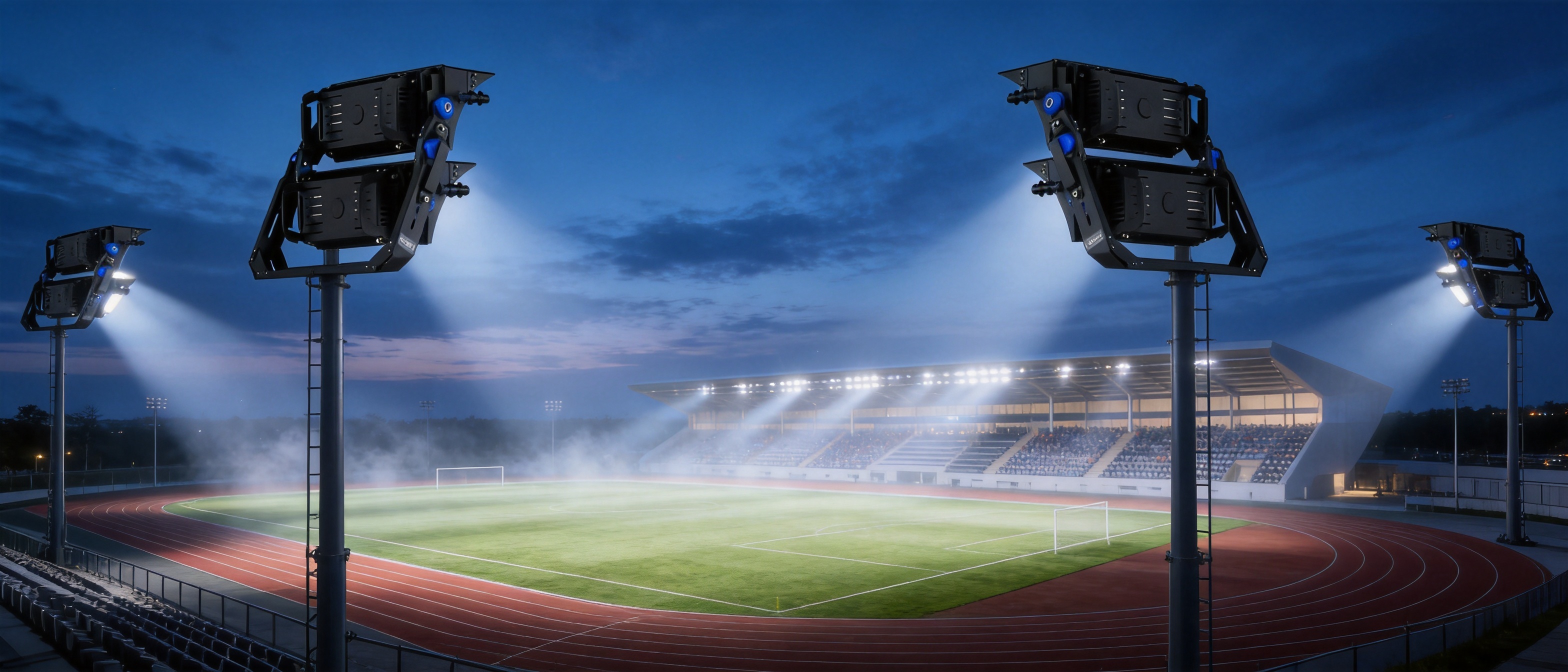
Sports lighting requires careful attention to illumination levels, uniformity, glare, shadowing, viewing directions, and broadcast or event requirements. The HS-LH can be evaluated for stadium fields, training grounds, athletic tracks, outdoor courts, spectator areas, service roads, and surrounding circulation spaces.
For a main field, lighting designers typically position multiple fixtures around the venue to create balanced coverage. Beam angles are selected according to the distance from each mounting point to the field. Narrower beams may be used for distant areas, while wider distributions may support nearer zones. The fixture’s control capability can assist with separate operating modes for training, competition, cleaning, security, and emergency procedures, depending on the project system.
Outdoor sports facilities also need lighting that does not create excessive distraction for players, spectators, nearby residents, drivers, or aircraft operations. The high-power capability of the HS-LH should therefore be paired with precise aiming, suitable optical selection, glare assessment, and professional commissioning. More power is not automatically better; useful performance comes from putting the right amount of light in the right location.
In smaller athletic facilities, the 500W or 1000W versions may be considered for selected zones. Larger venues may require 1500W, 2000W, or 3000W models, subject to the mounting structure and photometric design. The manufacturer’s ability to customize brackets can help address different tower and pole configurations.
9. Applications in Airports, Logistics Yards, and Industrial Sites
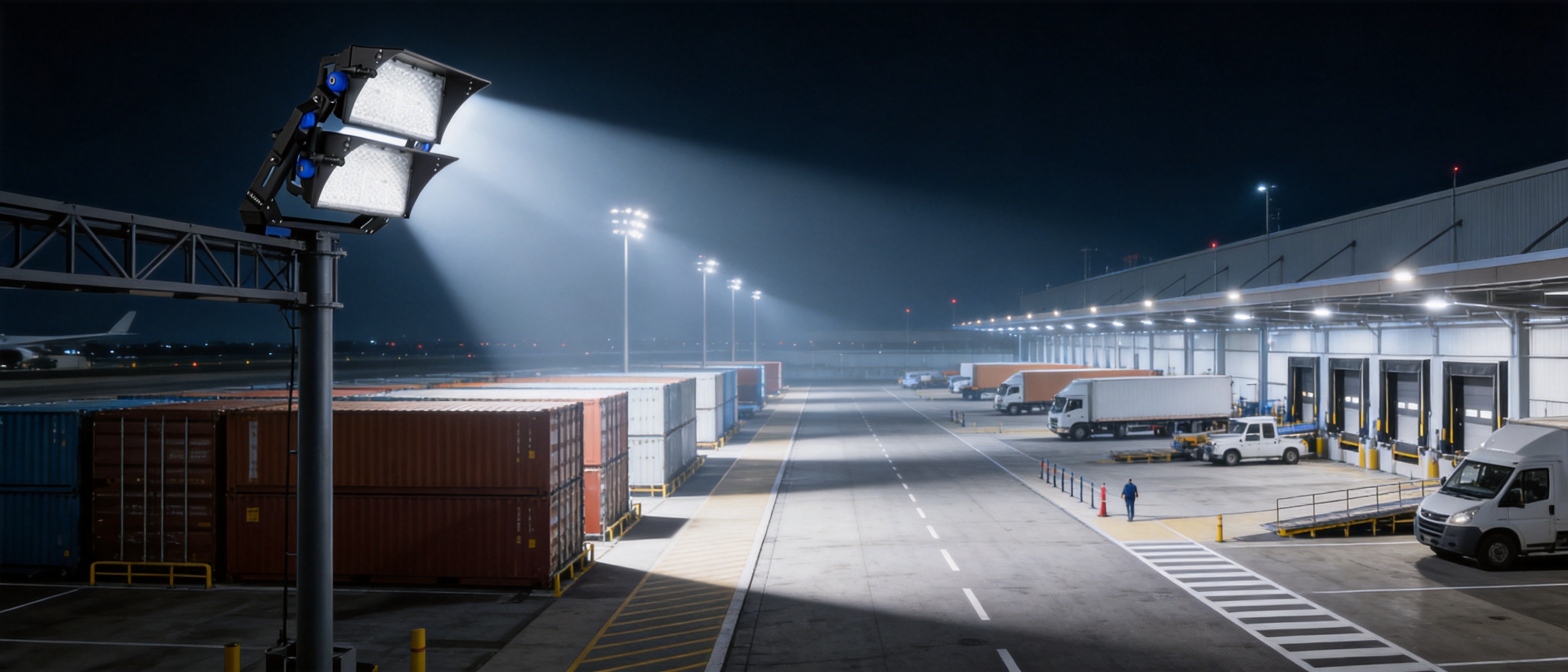
Airports and logistics facilities operate across large areas where visibility and safety are essential. Lighting may be required around cargo handling zones, service roads, loading areas, maintenance spaces, parking sections, and perimeter facilities. The HS-LH’s high output and optical range can support different area coverage requirements.
In logistics yards, good lighting helps operators identify vehicles, pallets, containers, loading equipment, and pedestrian routes. A combination of medium and high-power fixtures may be used to create layered illumination across the site. Wide beam angles can cover open loading areas, while narrower distributions can project light along roads or across long yard sections.
Industrial sites often contain dust, vibration, vehicle movement, and difficult maintenance conditions. A heavy-duty luminaire with corrosion-resistant housing and thermal management can be advantageous when compared with a light-duty fixture not intended for continuous outdoor exposure. Site operators should still confirm environmental ratings, mounting requirements, cleaning procedures, and any special hazardous-area requirements before installation.
The product category information includes LED industrial lighting and LED explosion-proof lighting as part of the manufacturer’s broader portfolio. However, the HS-LH should not automatically be treated as an explosion-proof product simply because it may be used in an industrial setting. Where flammable gases, vapors, or dust may be present, the project must use a product specifically certified and approved for the applicable hazardous location.
10. Public Squares, Municipal Areas, and Open Spaces
Public squares and municipal open spaces require a balance between visibility, comfort, appearance, and operating efficiency. The HS-LH can be considered for large plazas, civic event areas, transport hubs, public activity spaces, and wide pedestrian zones where ordinary decorative lighting is not sufficient.
Wide beam angles can help distribute light across open ground, while the product’s high-power options can support large areas with fewer mounting points. Housing color customization may help the fixture coordinate with an existing architectural palette or municipal visual standard. Bracket customization can also be useful where the product must be mounted on existing structures rather than standard poles.
For public projects, the lighting design should consider neighboring buildings, residences, road users, and environmental impact. Careful aiming and optical selection can reduce unnecessary upward or sideways light. A control system can further support scheduled operation, event scenes, and lower-output periods when full illumination is not required.
11. Manufacturing Strengths Behind the Product
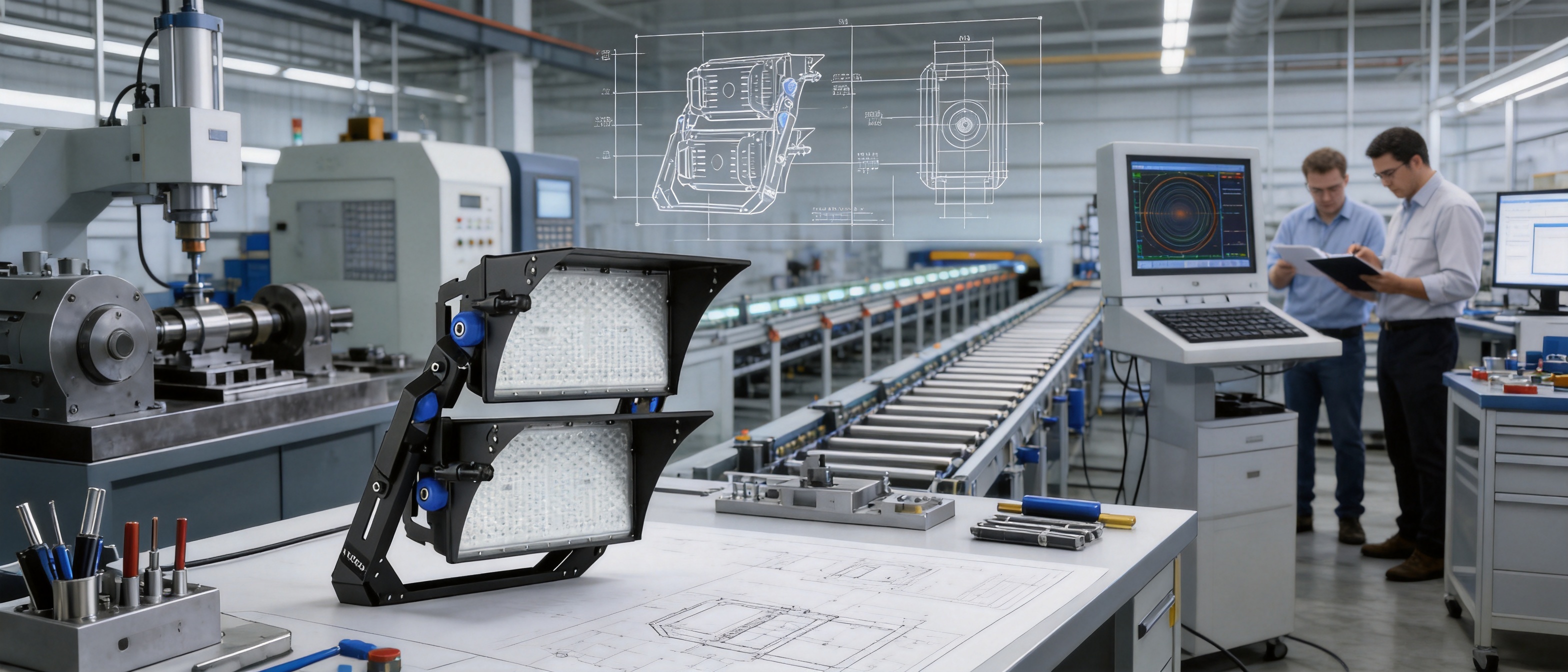
The performance of a high-power floodlight depends not only on its visible housing and LED modules but also on the manufacturing system used to produce and verify it. Cixi HuaSheng Lighting Co., Ltd. operates as a professional outdoor lighting manufacturer in Ningbo, China, with capabilities covering product development, manufacturing, customization, and export support.
The company has die-casting and CNC machines, aging lines, and goniophotometers. These facilities are relevant to the production of durable, accurately formed, and tested lighting products. Die-casting can support the production of strong and repeatable metal housing components. CNC machining can be used for precision processing, drilling, finishing, and fitting of components. These capabilities are especially valuable when a product requires stable mechanical dimensions and consistent assembly.
Aging lines support controlled operation testing before shipment. High-power LED products can be evaluated through aging procedures to identify certain early-stage electrical or assembly issues. While aging is not a substitute for complete quality control, it is an important part of a manufacturing process designed to improve product consistency.
Goniophotometers are used to measure light distribution and generate photometric data. For a floodlight with multiple lens angles, optical measurement is particularly important. It enables the manufacturer to examine beam distribution and provide information useful for lighting design, simulation, and product comparison.
The manufacturing system also includes mold design and die-casting support. This helps the company develop customized housings or brackets for OEM and ODM projects. Instead of relying entirely on off-the-shelf components, customers can discuss project-specific mechanical requirements with a manufacturer capable of supporting tooling and production development.
12. Quality, Environmental, and Occupational Management
The company reports certification to ISO 9001, ISO 14001, and ISO 45001. These standards address quality management, environmental management, and occupational health and safety management respectively. Certifications do not replace product-level testing or project compliance, but they indicate that the manufacturer has established formal management systems in these areas.
ISO 9001-oriented processes can support document control, production consistency, corrective action, supplier management, and customer feedback procedures. These elements are useful for large projects where repeatability and traceability matter. A stadium or municipal order may require multiple batches of similar fixtures, and controlled processes help reduce variation between production lots.
ISO 14001 relates to environmental management. Lighting manufacturing involves metals, electronic components, packaging, energy consumption, surface treatment, and waste control. An environmental management system can help the manufacturer identify and manage these impacts through documented procedures and improvement objectives.
ISO 45001 focuses on occupational health and safety. Manufacturing high-power lighting products involves machinery, metal processing, electrical testing, lifting, and assembly activities. A structured safety management system helps address workplace hazards and supports safer production operations.
The company also reports relevant products certified by CB and CE. Certification requirements depend on the exact product model, configuration, destination market, and applicable standards. Buyers should request the appropriate certificates and test documents for the exact HS-LH version under consideration.
13. OEM and ODM Services for Project Requirements
Lighting projects often have requirements that cannot be met by a standard catalog model. The pole structure may require a special bracket, the project designer may need a particular housing color, or the beam distribution may need adjustment to meet a site-specific plan. The HS-LH product program supports OEM and ODM cooperation for these situations.
Beam angle customization can help project teams seek a closer match between the fixture and the required coverage. Any optical change should be verified through photometric testing because changes to lenses or LED arrangements can affect intensity, uniformity, glare, and overall distribution.
Bracket design is another practical customization area. The mounting structure must support the product weight and account for wind, vibration, access, aiming adjustment, and cable routing. A customized bracket can be designed around an existing tower or pole, potentially simplifying installation. Structural calculations and local engineering approval remain necessary for the final application.
Housing color options can be useful for stadium architecture, municipal design standards, commercial facilities, and visual coordination with existing equipment. Although color is primarily an appearance-related choice, the selected surface treatment should also be suitable for outdoor exposure and corrosion resistance.
The company also offers mold design, SKD and CKD customization, efficient lighting solutions, and DIALux design support. These services may benefit importers, distributors, contractors, and project developers that require more than product supply. A one-stop approach can reduce communication gaps between optical planning, mechanical design, production, and delivery.
14. Engineering and Installation Considerations
Before selecting an HS-LH configuration, project teams should prepare a clear list of technical requirements. Important factors include the area to be illuminated, mounting height, distance to the target, required illuminance, uniformity, operating hours, ambient temperature, electrical supply, control method, and maintenance access.
Photometric planning should be completed using accurate product data for the selected power and beam angle. The 500W, 1000W, 1500W, 2000W, and 3000W versions have different dimensions, weights, and output levels. A design based on one model should not be assumed to apply directly to another model.
Mounting structures must be checked for weight and wind load. The 3000W version weighs 82 kilograms, while the 2000W version weighs 54.6 kilograms. These are significant loads, particularly when the fixtures are installed at height or mounted on extended brackets. Engineers should evaluate the pole, tower, foundation, fasteners, and adjustment mechanism as a complete system.
Electrical installation should include suitable circuit protection, grounding, cable sizing, isolation, and control wiring. The listed input voltage range must be matched with the actual supply. Where DC24V is required, the power source and voltage regulation system should be confirmed in advance. Installation work should be performed by qualified personnel in accordance with applicable electrical codes.
Maintenance planning should address cleaning, inspection, tightening of mounting hardware, cable condition, control system checks, and replacement procedures. Because the fixture may be installed in difficult-to-reach locations, a maintenance schedule can help identify problems before they cause service interruptions.
15. How the HS-LH Supports Total Project Value
The value of a stadium floodlight should be evaluated over its complete operating life rather than by purchase price alone. A fixture that is inexpensive at the time of purchase may become costly if it has poor thermal performance, limited optical choices, difficult installation, or frequent maintenance requirements.
The HS-LH supports project value through its broad power range, multiple beam angles, outdoor-oriented construction, and control options. These features can help project teams design a more suitable lighting system instead of adapting the site to a limited product selection.
The manufacturing capabilities of the supplier can also reduce project complexity. Die-casting, CNC machining, aging, optical testing, mold development, and customization are available within the company’s broader production system. This can support more direct communication when a project requires changes to mechanical components, optical arrangements, or delivery specifications.
For distributors, a complete product family creates opportunities to serve several market segments with one supplier. For contractors, customization and design support can simplify the process of responding to special project requirements. For owners, a properly specified high-power LED system can provide a stable platform for long-term outdoor operation.
Actual energy savings, service life, lighting performance, and maintenance cost depend on the final product configuration, operating schedule, installation conditions, electrical system, and maintenance practices. These factors should be evaluated using project-specific calculations and verified technical documents.
16. Recommended Selection Process
Step one is to define the application. Identify whether the project is a stadium, training field, airport, logistics yard, public square, industrial site, or another open area. Each application may have different requirements for visibility, uniformity, glare, operating hours, and control.
Step two is to collect site dimensions and mounting information. Record the height and position of poles or structures, the distance to the illuminated area, the presence of buildings or obstacles, and the available maintenance access.
Step three is to establish the target lighting performance. The required illumination level and uniformity should be determined according to the activity, local regulations, sports requirements, safety standards, and project owner expectations.
Step four is to compare power and beam options. Review the 500W to 3000W configurations and select lens angles from 15° to 120° based on the photometric plan. A combination of power levels and beam angles may provide a better result than using one configuration everywhere.
Step five is to confirm electrical and control requirements. Verify the input voltage, frequency, grounding arrangement, driver configuration, switch control, and PMX512 control requirements. Confirm whether the project requires a central management system or only basic on-and-off operation.
Step six is to review mechanical requirements. Check fixture weight, dimensions, bracket design, wind loading, cable routing, aiming adjustment, and lifting procedures. This step is especially important for the 1500W, 2000W, and 3000W versions.
Step seven is to request project documentation. Buyers should obtain the relevant datasheet, photometric files, certification documents, installation instructions, control information, and warranty terms for the exact configuration. If customization is required, drawings and approval samples should be reviewed before mass production.
17. Frequently Asked Questions
Q1: What is the primary purpose of the Outdoor Stadium Flood Light HS-LH?
The HS-LH is designed to provide high-intensity, long-distance illumination for stadiums and large outdoor areas. It can be considered for sports venues, airports, logistics yards, industrial sites, public squares, and other open environments requiring powerful LED floodlighting.
Q2: What power levels are available?
The Land Rover Series is listed in 500W, 1000W, 1500W, 2000W, and 3000W configurations. The appropriate model depends on the target area, mounting height, required lighting performance, optical distribution, and project design.
Q3: Which beam angles can be selected?
The listed lens angles are 15°, 30°, 45°, 60°, 90°, and 120°. Narrower angles are generally considered for more concentrated or longer-distance projection, while wider angles can support broader coverage. The final selection should be based on photometric calculations.
Q4: Can the product be used in an industrial yard?
Yes, the product can be evaluated for industrial yards, logistics areas, and other large outdoor sites. However, if the location is classified as a hazardous area containing flammable gases, vapors, or combustible dust, a specifically certified explosion-proof luminaire must be selected. The HS-LH should not be assumed to have hazardous-area approval without reviewing the exact certification.
Q5: Does the fixture support digital control?
The listed control modes are switch control and PMX512 control. The final capabilities depend on the driver, controller, wiring, and project programming. Customers should confirm the required control functions before ordering.
Q6: Is customization available?
OEM and ODM services include beam angle customization, bracket design, and housing color options. The company also provides mold design, SKD and CKD customization, and lighting design support. Customized solutions should be reviewed and approved through technical drawings and testing.
Q7: What manufacturing capabilities support the product?
The manufacturer operates die-casting and CNC machines, aging lines, and goniophotometers. These capabilities support housing production, precision machining, aging procedures, optical measurement, and product development. The company also reports ISO 9001, ISO 14001, and ISO 45001 certification.
Q8: How should the correct wattage be selected?
Wattage should not be selected solely by area or by comparing nominal power. The decision should consider mounting height, target distance, beam angle, required illuminance, uniformity, obstructions, operating schedule, and local standards. A professional lighting simulation is recommended.
Q9: Are the listed dimensions and weights the same for every model?
No. The listed configurations have different dimensions and weights. The 500W model weighs 11 kilograms, while the 3000W model weighs 82 kilograms. Project engineers should use the exact model data when designing the support structure and installation method.
Q10: What documents should be requested before purchase?
Customers should request the datasheet for the selected model, photometric information, installation instructions, electrical details, applicable certificates, control specifications, customization drawings if required, packaging information, and warranty terms. The exact document package may depend on the destination market and project requirements.
18. Conclusion
The Outdoor Stadium Flood Light HS-LH is a high-power LED lighting platform developed for stadiums and large outdoor applications. Its main strengths include power options from 500W to 3000W, beam angles from 15° to 120°, corrosion-resistant housing, thermal management, brand-name power supply, switch and PMX512 control, and support for OEM and ODM customization.
These characteristics make the series suitable for evaluating in sports venues, airports, logistics yards, industrial compounds, public squares, and other environments where powerful and stable illumination is needed. Compared with less specialized floodlights, the HS-LH provides a broader selection of output levels, optical distributions, control methods, and project customization possibilities.
The product is supported by a manufacturer with die-casting, CNC machining, aging, optical testing, mold development, and lighting design capabilities. Its reported ISO management certifications and CB and CE-related product certifications further support its position as an international lighting supplier. As with any high-power outdoor luminaire, final performance depends on correct photometric planning, structural engineering, electrical installation, control integration, and ongoing maintenance.
For project owners, contractors, distributors, and lighting designers, the HS-LH offers a practical foundation for developing tailored outdoor lighting systems. By matching the correct power, beam angle, mounting structure, and control method to the site, users can create a dependable lighting solution for demanding large-area applications.
References
1. Cixi HuaSheng Lighting Co., Ltd. Product information for the Outdoor Stadium Flood Light HS-LH and Land Rover Series.
2. International Organization for Standardization. ISO 9001: Quality Management Systems — Requirements.
3. International Organization for Standardization. ISO 14001: Environmental Management Systems — Requirements with Guidance for Use.
4. International Organization for Standardization. ISO 45001: Occupational Health and Safety Management Systems — Requirements with Guidance for Use.
5. International Electrotechnical Commission. General principles for the performance, safety, and testing of LED lighting equipment.
6. International Commission on Illumination. Guidance on outdoor lighting measurement, photometric distribution, glare evaluation, and lighting design.
Product: Outdoor Stadium Flood Light HS-LH

Solusi Kustom & OEM untuk Merek Pencahayaan Global
Hak Cipta © Cixi HuaSheng Lighting Co., Ltd. Semua Hak Dilindungi Undang-undang.
Pemasok Cetakan Die-Casting
