 English
 中文简体
 русский
 Français
 Español
 عربى
 Indonesia

Rugged Non-Isolated Smart LED Driver N6H: A High-Performance Platform for Demanding Industrial Lighting
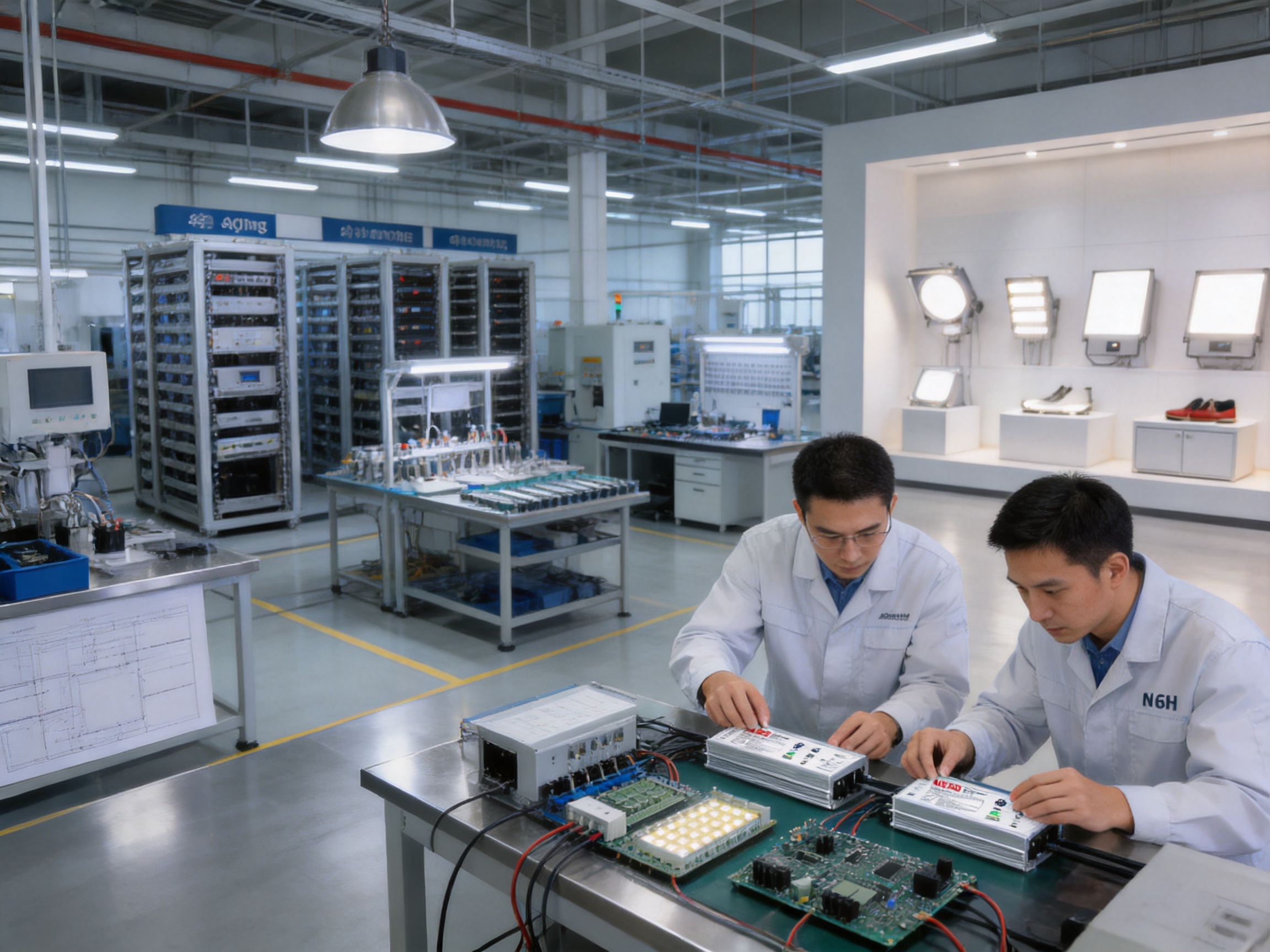
Modern industrial and outdoor lighting systems require more than a power conversion device that simply turns on an LED fixture. High-bay luminaires, floodlights, wall-mounted fixtures, and shoe-box lights often operate in environments where long feeder distances, unstable voltage, vibration, temperature variation, and frequent switching can expose weaknesses in ordinary drivers. A driver designed for these conditions must provide dependable constant-current regulation, practical dimming control, predictable performance, and a mechanical format that can be integrated into different luminaire designs.
The N6H Rugged Non-Isolated Smart LED Driver is developed for this type of demanding application. It provides non-isolated constant-current output across a broad 198–528 Vac input range and supports LED loads with output voltages from 180 to 260 Vdc. Its adjustable current ranges cover multiple power classes from 100 W to 320 W, allowing lighting manufacturers to select a suitable model for a wide variety of industrial and outdoor fixtures.
Beyond its electrical specifications, the N6H platform addresses several practical problems that frequently affect heavy-duty lighting installations. These include voltage instability on long industrial feeders, residual glow after dimming or switching off, limited control flexibility, and premature failure caused by vibration or challenging installation conditions. Three-in-one dimming, dimming-to-off capability, a zero-residual-glow design objective, a 12 V auxiliary supply, and potentiometer-based current adjustment give manufacturers useful options during product development and field commissioning.
Manufactured by Cixi HuaSheng Lighting Co., Ltd., the N6H is supported by an established lighting production system that includes die-casting and CNC equipment, aging lines, photometric testing resources, and OEM/ODM engineering services. This combination allows the driver to function not only as a standard component but also as part of a broader customized lighting solution.
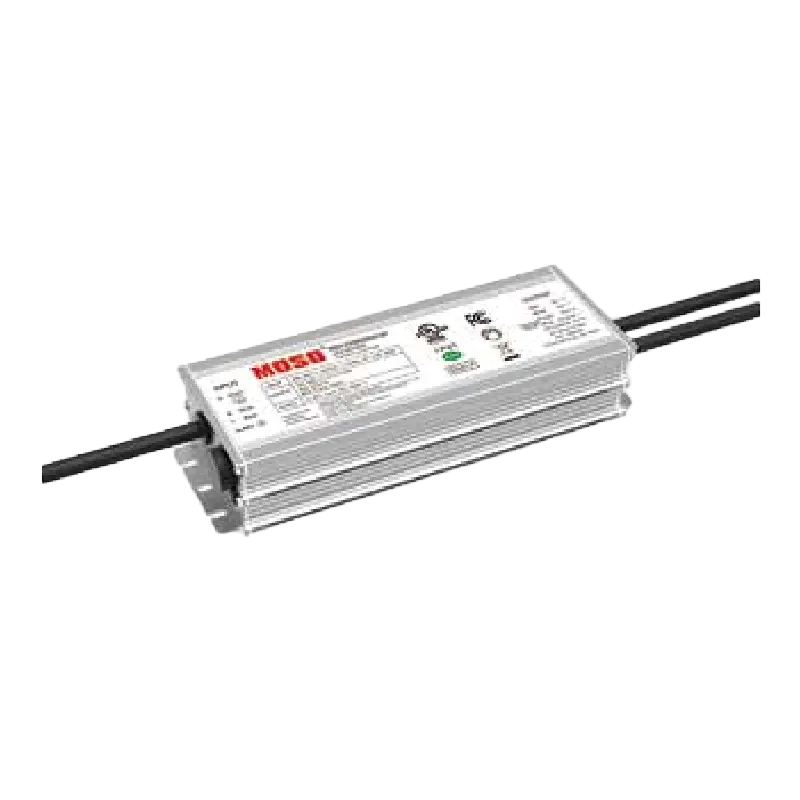
Rugged Non-Isolated Smart LED Driver N6H
1. Why the LED Driver Determines the Real Performance of a Fixture
LED modules are often promoted through their luminous output, efficacy, color quality, or mechanical appearance. However, the driver is equally important because it controls how electrical energy reaches the LEDs. A fixture can contain an efficient LED board and a carefully designed optical system, yet still deliver disappointing field performance if the driver cannot maintain stable current or tolerate the conditions of the installation.
In industrial and outdoor applications, input voltage may vary considerably. A luminaire installed at the end of a long feeder can experience voltage fluctuation, transient conditions, or electrical behavior that differs from the laboratory supply used during product testing. If the driver has a narrow operating range, the fixture may experience unstable output, flicker, nuisance shutdown, excessive stress, or shortened component life.
Constant-current regulation is especially important for high-power LEDs. LED forward voltage is affected by temperature, current, and device characteristics. A driver that does not regulate current effectively can cause output variation and accelerate thermal stress. The N6H is designed around a constant-current output architecture, helping the connected LED load operate within a controlled electrical range.
The choice between an isolated and non-isolated driver also influences the overall fixture design. Non-isolated architecture can support a compact form factor and efficient power conversion when the luminaire is engineered with appropriate electrical insulation, enclosure protection, grounding, and installation practices. For qualified fixture manufacturers, this architecture can reduce unnecessary size and support efficient integration into high-power luminaires.
Practical consequences of driver selection
A suitable driver affects several performance categories at once:
• Electrical stability: The driver must regulate current as input and load conditions change.
• Dimming quality: The control interface should respond predictably across the required operating range.
• Switching behavior: The fixture should turn off cleanly without unwanted afterglow.
• Thermal behavior: Conversion losses must be managed within the fixture’s available space and cooling system.
• Mechanical reliability: The driver should be suitable for the vibration and mounting conditions of its target application.
• Production flexibility: The design should allow the manufacturer to match current, output voltage, and mechanical arrangement to different fixture families.
The N6H addresses these requirements through one driver family with five power configurations. This gives manufacturers a consistent platform rather than forcing them to develop every fixture around a different electrical solution.
2. N6H Product Overview
The N6H family consists of the following models: N6H-100M260A12H, N6H-150M260A12H, N6H-200M260A12H, N6H-240M260A12H, and N6H-320M260A12H. The model names correspond to different power capacities, while the common output voltage range and control concept make the series suitable for related fixture designs.
All listed models support an output voltage range of 180–260 Vdc. Adjustable output current ranges vary according to power rating. The 100 W model can be adjusted from 0.30 to 0.50 A, while the 150 W version covers 0.37 to 0.75 A. The 200 W model covers 0.50 to 0.90 A, the 240 W model covers 0.60 to 1.10 A, and the 320 W model covers 1.10 to 1.48 A.
This adjustability is valuable because fixture manufacturers do not always use one LED board configuration across an entire product family. LED packages, board arrangements, thermal conditions, and target lumen outputs may vary. A current-adjustable driver allows the production team to tune the electrical operating point during development or commissioning, subject to the applicable design limits and thermal requirements.
| Model | Rated Power | Output Voltage Range | Adjustable Output Current | Typical Efficiency | Typical PF | Dimensions |
| N6H-100M260A12H | 100 W | 180–260 Vdc | 0.30–0.50 A | 93.00% | 0.97 | 177 × 68 × 39 mm |
| N6H-150M260A12H | 150 W | 180–260 Vdc | 0.37–0.75 A | 93.00% | 0.97 | 177 × 68 × 39 mm |
| N6H-200M260A12H | 200 W | 180–260 Vdc | 0.50–0.90 A | 94.00% | 0.97 | 202 × 68 × 39 mm |
| N6H-240M260A12H | 240 W | 180–260 Vdc | 0.60–1.10 A | 94.00% | 0.97 | 202 × 68 × 39 mm |
| N6H-320M260A12H | 320 W | 180–260 Vdc | 1.10–1.48 A | 94.00% | 0.97 | 212 × 68 × 39 mm |
The compact width of 68 mm across the family simplifies mechanical planning. Length increases with power level, while the height remains 39 mm in the listed specifications. This consistent dimensional concept can help manufacturers create a common mounting strategy for several wattage options.
3. Broad Input Operation for Industrial and Outdoor Networks
One of the principal advantages of the N6H is its wide 198–528 Vac input range. This range supports a broad variety of electrical supply conditions and can be particularly useful for lighting systems connected to industrial distribution networks. The wider operating window gives fixture designers more flexibility when specifying products for different regions, feeder arrangements, or voltage environments.
Long industrial feeders can introduce voltage variation between the distribution panel and the luminaire. A fixture may be installed far from the main electrical room, across a warehouse, along a manufacturing line, or in an outdoor area supplied through extended cable runs. In such cases, the voltage available at the fixture may not remain identical to the nominal system value.
A driver with a broad input range is better positioned to handle these variations than a narrow-range unit. It can reduce the need for separate driver versions designed around closely defined voltage categories. For manufacturers serving several markets, this may simplify product planning, inventory management, and fixture configuration.
The wide range also supports the development of luminaires for high-bay, flood, wall, and shoe-box applications without requiring the driver to be redesigned for every installation scenario. The actual suitability of a complete fixture still depends on system-level testing, wiring, protection, enclosure design, and local electrical requirements. Nevertheless, broad input capability gives the fixture a stronger starting point.
Reducing voltage-related field problems
Voltage instability can produce multiple symptoms in LED lighting. The fixture may not reach its expected output, may cycle on and off, or may experience variations in current and thermal behavior. In large facilities, even a small weakness in input tolerance can become a significant maintenance problem when dozens or hundreds of luminaires are installed.
The N6H is designed to address this type of challenge through its 198–528 Vac input specification. By accepting a wide voltage range, the driver helps manufacturers develop products intended for demanding networks rather than only controlled indoor supply conditions.
For a complete engineering evaluation, manufacturers should verify the driver together with the selected LED module, surge protection, wiring, enclosure, grounding arrangement, and installation environment. The driver’s broad input range is an important advantage, but system performance must always be confirmed at the luminaire level.
4. Constant-Current Output Across Five Power Classes
The N6H family covers 100 W, 150 W, 200 W, 240 W, and 320 W power classes. This range corresponds well with many industrial and outdoor lighting requirements. Smaller high-bay or wall-mounted fixtures may use the lower-power models, while larger floodlights, shoe-box luminaires, and high-output industrial fixtures can use the higher-power versions.
The common 180–260 Vdc output window is particularly useful for high-voltage LED arrays. It allows the designer to configure a suitable series connection of LED modules while keeping the current at a practical level for the selected power rating. The adjustable current range then provides an additional means of matching the driver to the optical and thermal design of the fixture.
For example, a 100 W design may operate at a current between 0.30 and 0.50 A, depending on the selected LED load and desired output. A 320 W system may require a substantially higher current, with adjustment available from 1.10 to 1.48 A. These ranges allow different current-density and thermal strategies within one product platform.
Adjustable current also supports product differentiation. A manufacturer may use the same housing and LED board architecture for several lumen packages, then set different driver current levels for standard, premium, or energy-saving versions. This can reduce tooling changes and simplify production compared with using entirely different fixed-current drivers.
Current adjustment and fixture development
During prototype development, the ideal operating current may not be known at the beginning. Thermal testing, photometric testing, and customer requirements can lead to changes. A potentiometer current adjustment provides a practical way to refine the operating point without immediately requiring a new driver design.
The adjustment feature can also support field adaptation when a project has specific power or light-output requirements. For example, a fixture may be installed in an area with a lower illumination target or a stricter energy budget. Subject to engineering controls and applicable operating limits, current adjustment can help the manufacturer create a more flexible product offering.
Current adjustment should always be completed by qualified personnel and verified through electrical, thermal, and photometric testing. The final current must remain compatible with the LED module, wiring, enclosure, and safety requirements of the complete luminaire.
5. Dimming-to-Off and Zero Residual Glow
Dimming performance is an important differentiator in commercial and industrial lighting. Many systems need more than a simple reduction in brightness. Warehouses, production areas, loading zones, parking facilities, and building exteriors may require the light to fade or reduce output during low-occupancy periods and then return to full brightness when needed.
The N6H supports three-in-one dimming and dimming-to-off functionality. This provides manufacturers with a flexible control foundation for fixtures that need adjustable output. The exact control implementation should be confirmed during system design, but the platform is intended to support modern dimming requirements without sacrificing its high-power industrial focus.
One notable design objective is zero residual glow. Residual glow, sometimes called afterglow, occurs when an LED fixture remains faintly illuminated after the control signal or mains supply is intended to switch it off. Even a small amount of unwanted light can create complaints in bedrooms, building perimeters, industrial work areas, or facilities where complete darkness is required.
Residual glow may be especially frustrating because it can be difficult to diagnose after installation. Users may interpret it as a wiring fault, control-system problem, or defective luminaire. By addressing dimming-to-off behavior in the driver design, the N6H helps manufacturers reduce the likelihood of this type of field complaint.
Benefits for lighting controls
Three-in-one dimming gives fixture manufacturers more than one control path for different project requirements. It can support product families intended for different control architectures, reduce the need for multiple driver platforms, and make the luminaire easier to integrate into building or industrial control systems.
For OEM customers, the dimming behavior can also be part of the customization process. Dimming curves, control response, and related parameters may be discussed during product development, depending on the required application and available engineering options.
A properly designed dimming system should be evaluated at minimum brightness, during transition, at full output, and at switch-off. Testing should include the selected LED module, external control device, wiring length, and any auxiliary equipment. The N6H provides the driver platform, while the final user experience depends on the complete system.
6. A 12 V Auxiliary Supply for Integrated Fixture Functions
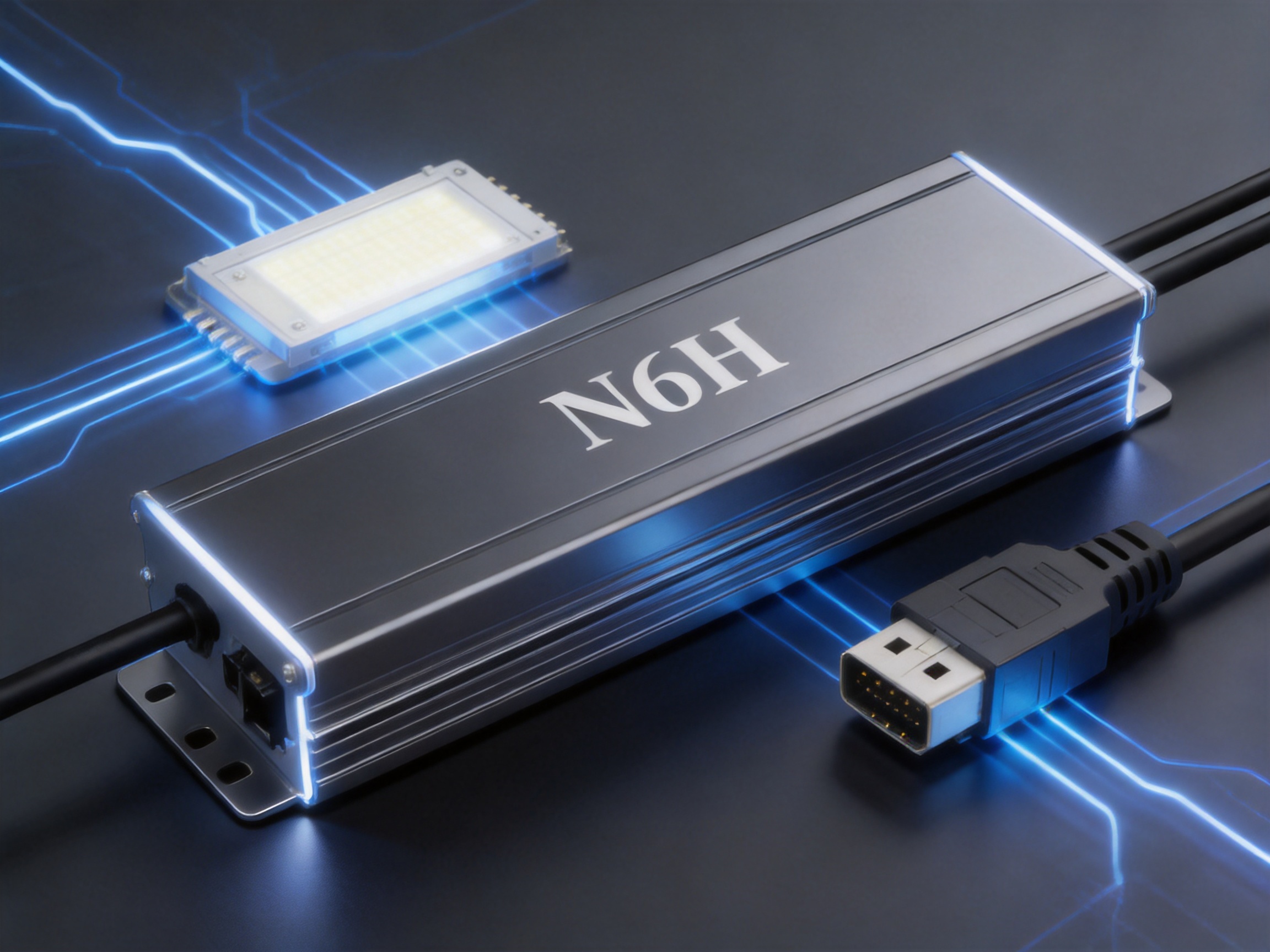
The N6H includes a 12 V auxiliary supply. This feature can simplify the integration of compatible control or monitoring components into a luminaire. Depending on the project design, an auxiliary supply may be useful for sensors, control interfaces, signaling circuits, or other low-voltage functions that require a stable source separate from the main LED output.
Integrating an auxiliary supply into the driver platform can reduce the need for a separate small power module. Fewer independent components may help save space, simplify wiring, and reduce the number of connection points inside the fixture. In a compact high-bay or floodlight housing, these advantages can have a direct effect on assembly efficiency and maintenance access.
The auxiliary supply also supports the development of smart or semi-smart fixtures. A lighting manufacturer may combine the N6H with occupancy detection, daylight response, remote control, status indication, or other project-specific functions. The precise electrical loading and compatibility must be evaluated for each design, but the built-in 12 V capability provides a useful foundation.
For OEM and ODM projects, the auxiliary output can be considered during the early mechanical and electrical architecture stage. This helps the manufacturer plan cable routes, connectors, mounting positions, and service access before tooling and production documentation are finalized.
7. Mechanical Design for Industrial Fixture Integration
The listed N6H dimensions are compact for the power range. The 100 W and 150 W models measure 177 × 68 × 39 mm. The 200 W and 240 W versions measure 202 × 68 × 39 mm, while the 320 W model measures 212 × 68 × 39 mm.
A consistent 68 mm width across all listed versions can simplify mounting design. Fixture housings can be developed around a common channel, bracket, or compartment width, while the length is adjusted for the selected power level. This is useful for manufacturers that want to build a family of luminaires with similar mechanical architecture.
Mechanical compatibility is particularly important in linear high-bay and floodlight products. These fixtures often have limited internal space because the housing must also accommodate the LED board, optical components, heat sink, surge protection, connectors, and wiring. A narrow driver profile helps the designer use available space efficiently.
In wall and shoe-box luminaires, the driver may be located in a dedicated gear compartment. The compact height can support a slimmer housing or provide additional clearance for thermal management. In every case, the driver must be mounted according to the manufacturer’s installation requirements and protected from conditions outside its intended operating environment.
Vibration and heavy-duty applications
Industrial lighting fixtures may be installed near machinery, conveyors, cranes, production equipment, ventilation systems, or other sources of vibration. Mechanical stress can affect solder joints, connectors, mounting points, and internal components over time. A driver intended for demanding applications should therefore be evaluated not only for electrical performance but also for mechanical integration.
The N6H product concept specifically addresses vibration-induced failures that can occur in heavy-duty settings. Manufacturers can further improve reliability by using secure mounting, appropriate cable strain relief, controlled thermal interfaces, and a housing structure that limits movement.
The complete fixture should be tested under representative vibration and temperature conditions. A high-quality driver cannot compensate for a weak mounting system or poorly supported internal wiring. However, selecting a rugged driver platform is an important step toward a more durable industrial luminaire.
8. Efficiency and Power Factor
The N6H models provide typical efficiency ratings of 93.00% for the 100 W and 150 W versions and 94.00% for the 200 W, 240 W, and 320 W versions. These values indicate that most of the input power is converted into useful LED output, with a comparatively limited portion becoming heat inside the driver.
Efficiency matters because every watt lost as heat must be managed by the luminaire. Lower driver losses can reduce internal temperature, support a more compact thermal design, and contribute to improved long-term component conditions. In large installations, even a small improvement in conversion efficiency can reduce total energy consumption and heat generation across many fixtures.
The typical power factor is 0.97 across the listed models. A high power factor is beneficial for installations with many luminaires because it helps reduce the difference between real power and apparent power. This can support more efficient use of electrical infrastructure and reduce unnecessary current demand in the distribution system.
Power factor and efficiency should be verified under the intended input voltage, output power, and operating temperature. The published values provide a reference for product selection, while final system performance depends on the specific operating point and installation conditions.
| Performance Feature | Value or Function | Practical Benefit |
| Input voltage | 198–528 Vac | Supports varied and unstable industrial or outdoor supply conditions |
| Output voltage | 180–260 Vdc | Suitable for high-voltage LED array configurations |
| Output control | Constant current with adjustable ranges | Allows matching to different LED modules and lumen packages |
| Dimming | Three-in-one dimming | Provides flexible control integration |
| Switch-off behavior | Dimming-to-off and zero residual glow design objective | Helps reduce unwanted afterglow complaints |
| Auxiliary output | 12 V supply | Supports compatible sensors, interfaces, and control functions |
| Typical efficiency | 93.00%–94.00% | Helps limit driver heat and energy losses |
| Typical power factor | 0.97 | Supports efficient use of electrical capacity |
9. Competitive Advantages Compared with Conventional Alternatives
The N6H competes not only with other LED drivers but also with design approaches that may require more components, narrower operating conditions, or less flexible control arrangements. Its strongest advantages become clear when the driver is evaluated against the practical requirements of industrial and outdoor fixture production.
Wide input range versus narrow-range drivers
Many conventional drivers are designed around a relatively limited input voltage category. This can require manufacturers to maintain several driver versions for different markets or electrical systems. The N6H’s 198–528 Vac input range can reduce this fragmentation and make one platform applicable to a broader set of projects.
This is especially valuable for export-oriented manufacturers. A common driver platform can simplify technical documentation, purchasing, assembly training, and spare-parts planning. Project engineers can still select the appropriate model based on power and current requirements while retaining a consistent control and mechanical concept.
Adjustable current versus fixed-current limitations
A fixed-current driver may be adequate for a single standardized luminaire, but it can become restrictive when the manufacturer wants to offer several lumen outputs or use different LED boards. The N6H adjustable current ranges provide more development and production flexibility.
Adjustability can also reduce the need for repeated driver redesigns when a customer requests a moderate change in light output or power consumption. This can shorten the path from prototype to production, provided that each operating point is properly validated.
Dimming-to-off versus residual glow problems
In applications where darkness is important, a driver that only reduces output without fully extinguishing the LED load may create dissatisfaction. The N6H is designed to support dimming-to-off and zero residual glow, directly addressing a common weakness of poorly matched LED control systems.
Eliminating unwanted afterglow can improve the perceived quality of a finished luminaire. It can also reduce installation troubleshooting and help the fixture perform more predictably with external control equipment.
Integrated auxiliary supply versus additional modules
A separate auxiliary power module takes up space, adds wiring, and introduces additional points of failure. The N6H’s 12 V auxiliary supply can help manufacturers integrate compatible functions more efficiently. This is not only a space-saving feature; it can also simplify assembly and service procedures.
One family versus disconnected product selections
The five N6H power classes provide a coherent family from 100 W to 320 W. Manufacturers can develop related high-bay, flood, wall, and shoe-box products around a shared driver philosophy. This makes it easier to standardize testing procedures, assembly practices, and technical support.
These advantages do not mean that every project should use the same model. The correct selection still depends on LED voltage, current, thermal behavior, enclosure design, dimming requirements, and regional compliance requirements. The strength of the N6H is that it gives the manufacturer a flexible platform from which to make those selections.
10. Applications for the N6H Platform
Linear high-bay lighting
Linear high-bay fixtures are commonly used in warehouses, logistics centers, workshops, factories, and distribution facilities. These luminaires often operate for long periods and may be installed at considerable height, making maintenance expensive. A driver with broad input tolerance, adjustable current, high power factor, and practical dimming functions can support more dependable operation.
The narrow 68 mm width of the N6H models is useful for elongated fixture housings. Depending on the selected power class, the driver can be positioned alongside or behind the LED assembly while leaving room for thermal pathways and wiring.
Floodlighting
Floodlights are used for yards, façades, sports areas, industrial compounds, storage zones, and security applications. They may face long cable runs, outdoor voltage variation, frequent control changes, and challenging environmental conditions. The N6H’s broad input range and dimming-to-off capability can support floodlight designs that need both high output and controlled operation.
For outdoor floodlights, the driver must be installed within a suitably protected enclosure. The fixture manufacturer should evaluate condensation, temperature, cable entry, surge protection, corrosion exposure, and service access as part of the complete design.
Wall-mounted luminaires
Wall lights and area lights may be used around industrial buildings, commercial properties, tunnels, loading areas, and public facilities. These products often need a slim profile and reliable operation in a wide variety of supply environments.
The N6H’s compact dimensions and adjustable output can help manufacturers create different wall-light configurations without changing the entire electrical platform. Dimming-to-off may be especially useful for perimeter lighting, where the fixture must remain available but should not produce unwanted light during inactive periods.
Shoe-box luminaires
Shoe-box fixtures are widely used for parking areas, roads, pathways, campuses, and large outdoor sites. They require a driver that can fit inside a compact housing while supporting the desired lumen output and control system.
The N6H power range allows the designer to select a suitable capacity for moderate or high-output shoe-box luminaires. Its high typical power factor and efficiency are also relevant to projects containing a large number of fixtures connected to the same distribution network.
11. OEM and ODM Customization Capabilities
Different lighting manufacturers have different requirements for surge performance, dimming profiles, mechanical interfaces, wiring, connectors, and installation methods. A standard product may provide the electrical foundation, but customization is often necessary for a complete commercial luminaire platform.
OEM and ODM services allow customers to discuss adaptations to the N6H design. Potential customization areas include surge levels, dimming profiles, mechanical interfaces, and other project-specific details. The purpose of this process is to align the driver with the customer’s fixture structure and market requirements rather than treating the driver as an isolated component.
Mechanical customization may include mounting arrangements, connector positions, cable lengths, or interface details. These changes can reduce assembly time and improve compatibility with the customer’s housing. Electrical customization may involve control behavior, current settings, or auxiliary functions, subject to technical feasibility and validation.
Customization should begin with a clear technical specification. The customer should provide the target power, LED voltage, current range, input system, dimming method, installation environment, expected operating temperature, mechanical envelope, and applicable compliance requirements. Early coordination helps prevent costly changes after tooling or certification work has begun.
From prototype to production
A structured OEM/ODM process generally includes requirement confirmation, engineering review, sample preparation, electrical testing, thermal evaluation, mechanical verification, and production approval. This approach gives the manufacturer and customer an opportunity to identify design issues before mass production.
The N6H’s common platform can shorten this process because the basic electrical architecture is already defined. The customization effort can focus on adapting the driver to the fixture rather than developing an entirely new power system from the beginning.
12. Manufacturing Strengths Behind the Product
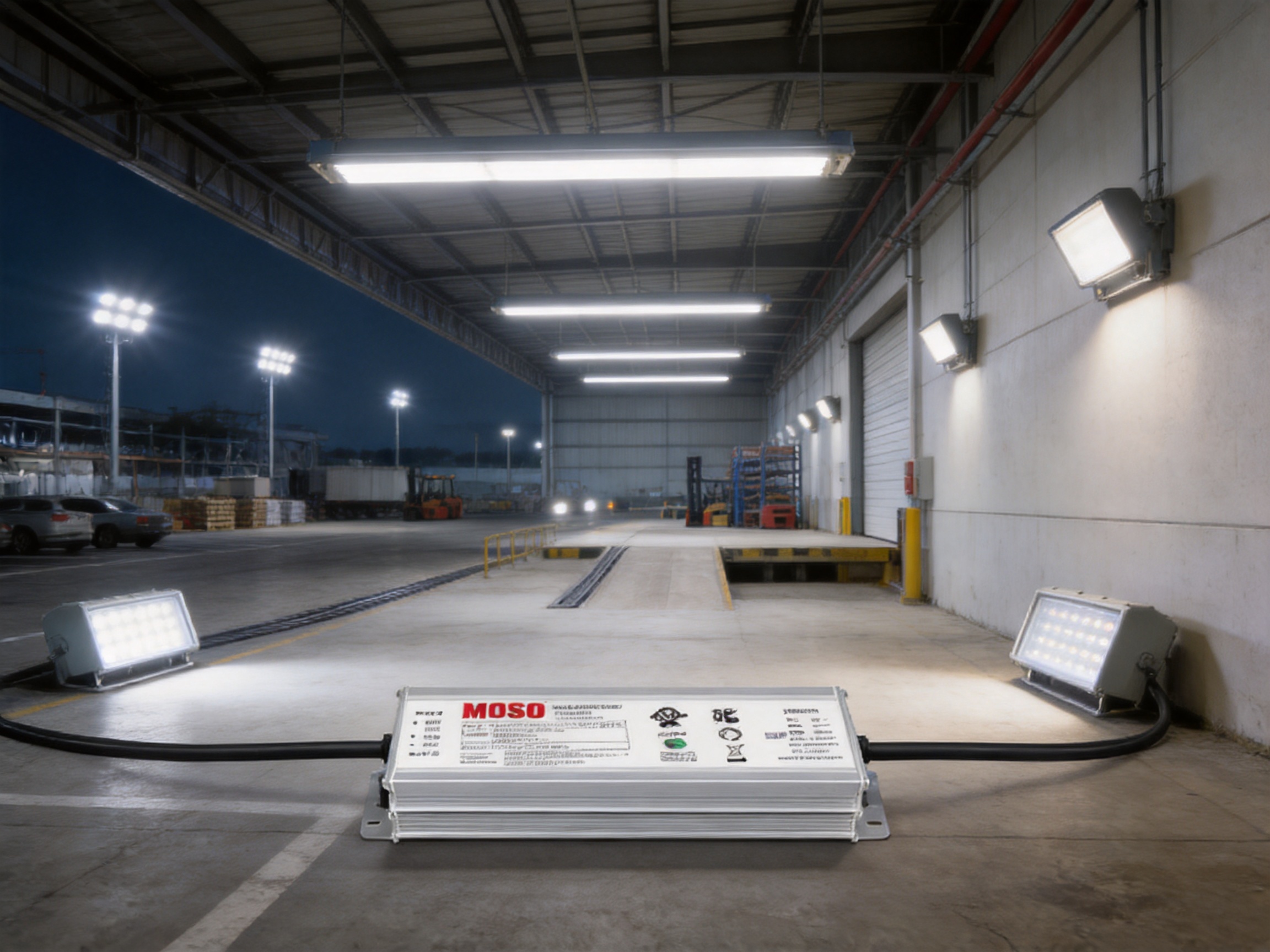
The performance of a driver depends not only on its circuit design but also on how consistently it is manufactured, tested, assembled, and integrated into the final product. Cixi HuaSheng Lighting Co., Ltd. supports its lighting business with production and engineering resources intended for a broad range of indoor, outdoor, industrial, and specialty lighting products.
The company operates die-casting and CNC machining equipment. These capabilities are important for lighting products that require accurately formed metal housings, heat sinks, brackets, covers, and mechanical interfaces. Die-casting can support repeatable production of complex metal forms, while CNC machining can provide precise finishing and dimensional control for selected components.
For a driver-based luminaire, mechanical precision affects more than appearance. It can influence heat transfer, component positioning, mounting security, sealing interfaces, cable routing, and compatibility between the driver and the fixture body. Integrated manufacturing resources can help the lighting manufacturer coordinate these details more efficiently.
The company also operates aging lines. Aging is an important production-stage process for identifying early electrical or assembly abnormalities before products are shipped. By operating products under controlled conditions for a defined period, manufacturers can screen for certain issues that may not appear during a brief functional check.
Photometric equipment, including goniophotometers, supports the measurement and evaluation of lighting distribution. Although a driver is primarily an electrical component, its actual performance must be considered as part of the complete luminaire. Photometric testing can help confirm that changes in current, thermal conditions, optics, or mechanical structure produce the intended light distribution and output.
Quality and environmental management
Cixi HuaSheng Lighting Co., Ltd. is identified as certified to ISO 9001, ISO 14001, and ISO 45001. These management systems relate respectively to quality management, environmental management, and occupational health and safety. Such systems provide a framework for controlled processes, continual improvement, environmental responsibility, and safer manufacturing practices.
The company also states that relevant products have CB and CE certifications. Certification status should always be confirmed for the specific model, configuration, destination market, and final luminaire, because the compliance requirements of a driver may differ from those of a complete lighting product.
The combination of manufacturing equipment, aging capability, photometric resources, and management systems gives OEM customers a broader support structure than a simple component trading relationship. It allows electrical, mechanical, optical, and production considerations to be discussed within one lighting manufacturing organization.
13. Integrated Lighting Engineering and Project Support
In addition to manufacturing LED products, the company provides lighting solution services, DIALux designs, mold design, OEM/ODM development, SKD/CKD customization, and delivery support. These services are relevant to customers that need more than a driver quotation.
DIALux design support can help project teams evaluate illumination levels, uniformity, mounting height, spacing, beam distribution, and fixture quantity. When the selected driver is integrated into the luminaire design, the lighting calculation can be linked to the actual power and lumen configuration of the product.
Mold design capability is useful when a customer requires a customized housing, reflector, bracket, or die-cast component. Because the driver dimensions and mounting requirements can be considered during the mechanical design stage, the resulting fixture may have a more coherent internal arrangement.
SKD and CKD customization can support customers with different assembly strategies. Some customers may prefer complete fixtures, while others may require semi-knocked-down or completely knocked-down arrangements for local assembly, distribution, or market-specific production. A flexible supply model can be valuable for international projects.
The company’s product portfolio includes street lights, tunnel lights, high-bay lights, linear lights, garden lights, solar lights, grow lights, explosion-proof lights, and other lighting products. This broad product experience can help the manufacturer understand how drivers behave across different fixture structures and application environments.
14. Design Considerations for Fixture Manufacturers
Although the N6H is designed for demanding applications, successful use requires careful system engineering. The driver should be selected according to the LED module’s forward-voltage range, target current, rated power, thermal conditions, control requirements, and available physical space.
The non-isolated architecture requires particular attention to electrical insulation and installation. The complete luminaire must be designed so that accessible conductive parts, LED boards, wiring, and mounting structures meet the relevant safety requirements. Clearances, creepage distances, grounding, enclosure construction, and service procedures should be evaluated by qualified engineers.
Thermal design is equally important. The driver’s efficiency reduces internal losses, but the remaining heat still must be transferred away effectively. The fixture housing, heat sink, mounting surface, airflow, ambient temperature, and LED board should be evaluated together. Testing should be performed at maximum intended current and under the highest relevant ambient conditions.
Dimming tests should include the intended external control equipment. The manufacturer should verify that the fixture reaches the required minimum output, responds smoothly, turns off correctly, and does not show flicker or residual glow under the expected wiring arrangements.
Mechanical tests should confirm that the driver remains securely mounted during transportation, installation, and operation. In industrial applications, vibration, repeated switching, temperature cycling, and maintenance access should be part of the product validation plan.
Recommended engineering verification
Before mass production, manufacturers should consider the following checks:
• Input operation across the required voltage range.
• Output current accuracy at minimum, nominal, and maximum adjustment settings.
• LED output voltage compatibility from 180 to 260 Vdc.
• Efficiency and power factor under representative load conditions.
• Dimming response with the intended control method.
• Dimming-to-off behavior and residual-glow evaluation.
• Auxiliary 12 V output loading and compatibility.
• Thermal performance inside the final housing.
• Mechanical mounting strength and vibration resistance.
• Surge and protection performance according to the project specification.
• Compliance testing for the destination market and complete luminaire.
15. Selection Guide by Power Requirement
The correct N6H model should be selected according to the electrical requirements of the LED load rather than by wattage alone. The LED forward-voltage range must fall within the driver’s 180–260 Vdc output range, and the required current must fall within the selected model’s adjustable current range.
| Target Fixture Class | Recommended Starting Model | Current Range | Typical Application Direction |
| Up to approximately 100 W | N6H-100M260A12H | 0.30–0.50 A | Compact industrial, wall, or lower-output flood fixtures |
| Approximately 150 W | N6H-150M260A12H | 0.37–0.75 A | Medium-output high-bay, wall, or area luminaires |
| Approximately 200 W | N6H-200M260A12H | 0.50–0.90 A | High-bay, flood, and shoe-box fixtures |
| Approximately 240 W | N6H-240M260A12H | 0.60–1.10 A | High-output industrial and outdoor luminaires |
| Approximately 320 W | N6H-320M260A12H | 1.10–1.48 A | Large flood, shoe-box, and high-power industrial fixtures |
This table is a starting point rather than a substitute for electrical design. The LED module’s actual forward voltage, thermal behavior, desired lumen output, dimming requirements, and installation conditions should determine the final model.
16. Why the N6H Is Suitable for Global OEM Projects
Global lighting manufacturers often need products that can be adapted to multiple markets without losing consistency. The N6H supports this objective through a broad input range, five power levels, adjustable current, flexible dimming, a 12 V auxiliary supply, and a compact mechanical concept.
These features can help reduce the number of unrelated driver platforms in a product portfolio. A manufacturer may use the lower-power models for compact wall and high-bay products, then use the higher-power models for floodlights and shoe-box luminaires. The same basic control philosophy can be maintained across the range.
The company’s OEM/ODM services further support international customers that need changes in mechanical interfaces, surge levels, dimming behavior, or product documentation. Engineering collaboration is especially important when the finished luminaire will be certified or sold in several regions.
Production support is also significant. Die-casting, CNC machining, aging lines, photometric equipment, and lighting assembly knowledge can help customers coordinate the driver with the fixture structure. This integrated approach may reduce communication gaps that can occur when electrical, mechanical, and optical components are sourced from unrelated suppliers.
17. Frequently Asked Questions
What type of driver is the N6H?
The N6H is a rugged non-isolated smart LED driver designed to provide constant-current performance for industrial and outdoor LED fixtures.
What input voltage can the N6H accept?
The specified input range is 198–528 Vac. This broad range is intended to support demanding supply conditions, including applications affected by long industrial feeders and voltage variation.
What output voltage range does the N6H provide?
All listed models provide an output voltage range of 180–260 Vdc. The LED load should be selected so that its operating voltage falls within this range.
Which power ratings are available?
The N6H family includes 100 W, 150 W, 200 W, 240 W, and 320 W models.
Is the output current adjustable?
Yes. Each model has a defined adjustable output current range, and the driver includes potentiometer-based current adjustment. The adjustment must remain within the rated range and be validated with the complete LED fixture.
Does the driver support dimming?
Yes. The N6H supports three-in-one dimming and dimming-to-off functionality. The external control method and final dimming performance should be tested with the selected luminaire and control system.
What does zero residual glow mean?
Zero residual glow refers to the design objective of preventing unwanted faint illumination after the fixture is commanded to switch off. This feature can help reduce afterglow complaints in applications requiring a clean off state.
Does the N6H include an auxiliary power output?
Yes. The driver includes a 12 V auxiliary supply for compatible control, sensor, monitoring, or interface functions.
What fixtures are suitable for the N6H?
The core application areas include linear high-bay, flood, wall, and shoe-box luminaires. The final suitability depends on the LED load, enclosure, thermal design, control system, and installation conditions.
Is the N6H suitable for vibration-prone environments?
The product is intended for demanding heavy-duty settings and addresses vibration-induced failure concerns. However, the complete fixture still requires suitable mounting, wiring support, enclosure design, and vibration testing.
What are the typical efficiency values?
The 100 W and 150 W models have typical efficiency of 93.00%. The 200 W, 240 W, and 320 W models have typical efficiency of 94.00%.
What is the typical power factor?
The typical power factor for the listed N6H models is 0.97.
Can the driver be customized?
OEM and ODM customization services are available. Potential adaptation areas include surge levels, dimming profiles, and mechanical interfaces, subject to engineering review and project requirements.
What should be checked before using a non-isolated driver?
The complete luminaire should be evaluated for insulation, grounding, creepage, clearance, enclosure protection, accessible conductive parts, wiring, and applicable safety requirements. Non-isolated architecture should be integrated only by qualified lighting engineers.
Can the N6H be used in a complete outdoor luminaire?
It can be considered for suitable outdoor fixture designs such as floodlights, wall lights, and shoe-box luminaires. The driver must be protected within an appropriate enclosure, and the complete product must be tested for temperature, moisture, surge, corrosion, and environmental exposure.
18. Conclusion
The N6H Rugged Non-Isolated Smart LED Driver is designed for lighting manufacturers that need stable, adjustable, and configurable power conversion in demanding industrial and outdoor applications. Its 198–528 Vac input range addresses broad supply conditions, while the 180–260 Vdc output range supports high-voltage LED arrays across five power classes.
Its advantages extend beyond basic electrical conversion. Adjustable current supports different LED boards and lumen packages. Three-in-one dimming provides control flexibility. Dimming-to-off and zero residual glow address practical user complaints. The 12 V auxiliary supply supports compatible smart-lighting functions, and the compact mechanical format helps manufacturers integrate the driver into high-bay, flood, wall, and shoe-box luminaires.
Compared with narrow-range, fixed-current, or less flexible alternatives, the N6H can help simplify product development and support a broader range of fixture designs. The platform is particularly suitable for OEM and ODM customers that need customized surge performance, dimming behavior, or mechanical interfaces.
The product is also supported by a lighting manufacturer with die-casting and CNC production resources, aging lines, photometric equipment, mold design capability, DIALux support, and international customization services. These resources allow the driver to be evaluated as part of a complete lighting solution rather than as an isolated electrical component.
For manufacturers developing reliable industrial and outdoor LED fixtures, the N6H offers a balanced combination of wide input tolerance, constant-current control, adjustable output, dimming capability, auxiliary power, compact dimensions, and production flexibility. When correctly integrated and validated at the complete-luminaire level, it can provide a strong foundation for efficient, durable, and application-specific lighting products.
References
1. LED driver design principles for constant-current lighting applications.
2. Industrial lighting engineering practices for high-bay, floodlight, wall-light, and shoe-box luminaires.
3. Power conversion efficiency and power factor considerations in LED lighting systems.
4. General principles of LED dimming, dimming-to-off behavior, and residual-glow control.
5. Lighting fixture thermal management and electrical integration guidelines.
6. ISO 9001 quality management system principles.
7. ISO 14001 environmental management system principles.
8. ISO 45001 occupational health and safety management system principles.
9. General photometric evaluation practices for professional LED luminaires.
10. Manufacturer-provided N6H product specifications and application information.
Product: Rugged Non-Isolated Smart LED Driver N6H

Solusi Kustom & OEM untuk Merek Pencahayaan Global
Hak Cipta © Cixi HuaSheng Lighting Co., Ltd. Semua Hak Dilindungi Undang-undang.
Pemasok Cetakan Die-Casting
