 English
 中文简体
 русский
 Français
 Español
 عربى
 Indonesia

Reliable High Current Power Supply T30-500W for Demanding Industrial Applications
Industrial equipment depends on a stable, predictable, and adequately sized power source. When automation machinery, control systems, commercial equipment, or high-power LED installations require continuous current, the power supply becomes more than a basic conversion component. It is a central part of system reliability, safety, operating efficiency, and maintenance planning. An unsuitable supply can lead to voltage instability, excessive ripple, nuisance shutdowns, electromagnetic interference, overheating, or premature component failure.
The Reliable High Current Power Supply T30-500W is designed for applications that require substantial output current in a practical industrial format. Model MS-TB100J240-500C0 provides a 24V/21A output from a universal 90–264Vac input range at 47–63Hz. With a 500W output class, power factor above 0.95, surge protection, and a compact 230*127*40 mm housing, it offers a balanced solution for engineers who need high current without unnecessarily complicated integration.
This power supply is suitable for automation machinery, industrial control panels, commercial equipment, LED installations, and other high-current systems. Its specifications address several common concerns at the same time: broad input compatibility, high output capacity, power quality, surge resistance, manageable dimensions, and internationally recognized certifications. These characteristics make it a practical option for equipment builders, lighting manufacturers, system integrators, and project contractors.
Reliable High Current Power Supply T30-500W
Why High-Current Power Supplies Matter in Industrial Systems
Industrial loads frequently operate for long periods and may experience frequent starting, stopping, switching, or changes in demand. Motors, relays, controllers, sensors, communication devices, LED modules, fans, and other components can all place different requirements on a shared power source. A power supply must therefore deliver consistent voltage while handling variations in the input network and the connected load.
A 24V output is widely used in industrial environments because it provides a useful balance between safety, transmission efficiency, component availability, and system compatibility. However, the current requirement can vary considerably from one application to another. Small control systems may need only a few amperes, while large LED arrays, automation assemblies, and commercial machines may require much more. A 21A output gives system designers greater capacity for demanding loads and provides additional operating margin when the application is properly specified.
Insufficient current capacity can cause output voltage to fall under load. In an industrial system, that can result in malfunctioning controllers, dimming or flickering LED products, intermittent communication, contactor problems, or repeated equipment resets. Selecting a supply with appropriate capacity helps reduce the risk of these conditions. It can also support future expansion when additional devices are added to a control cabinet or lighting system.
Power quality is equally important. A supply may have a sufficient nominal wattage but still perform poorly if it produces excessive ripple, responds poorly to input disturbances, or lacks suitable protection. The T30-500W addresses these issues through a 200mV peak-to-peak ripple specification, a universal AC input range, high power factor, and common-mode and differential-mode surge protection.
Product Overview and Core Specifications
The T30-500W is a 500W-class industrial power supply designed to convert standard AC mains into a stable 24V DC output. Its 21A output rating supports high-current applications without requiring multiple smaller power supplies in many installations. Consolidating the required output into one supply can simplify wiring, reduce the number of mounting points, and make system servicing more straightforward.
| Specification | Product Detail |
|---|---|
| Product | Reliable High Current Power Supply T30-500W |
| Model | MS-TB100J240-500C0 |
| Input Voltage | 90–264Vac |
| Input Frequency | 47–63Hz |
| Output | 24V/21A |
| Output Power Class | 500W |
| Surge Protection | Common mode: 4KV; differential mode: 2KV |
| Ripple Peak-to-Peak | 200mV |
| Power Factor | Greater than 0.95 |
| Dimensions | 230*127*40 mm |
| Certifications | CB, CE, UKCA, UL, FCC |
The input range of 90–264Vac allows the supply to operate across a wide range of mains conditions and regional electrical systems. This is particularly valuable for equipment intended for export, because designers can use one supply platform in multiple markets rather than developing separate electrical configurations for each nominal voltage. The 47–63Hz frequency range also accommodates common 50Hz and 60Hz power networks.
The 24V/21A output is suitable for systems with substantial current requirements. A 21A rating corresponds to a nominal 504W output at 24V, while the product is identified as a 500W-class supply. Application engineers should always confirm the detailed operating conditions, derating requirements, ambient temperature, ventilation, and load profile before final installation.
Stable 24V Output for High-Load Equipment
Stable voltage conversion is essential for industrial electronics. Many controllers and devices are designed around a defined DC operating voltage, and even moderate variation may affect performance. A reliable 24V supply helps maintain predictable operation for control components, LED systems, monitoring devices, and other equipment.
The high-current output also allows the supply to support centralized distribution. Instead of installing several lower-capacity supplies, an integrator may be able to use one appropriately selected 500W unit. This can simplify the architecture of a control cabinet and reduce the number of AC input connections, output branches, and individual service points.
Centralized power distribution is not automatically the right choice for every installation. Large systems may require separate supplies for isolation, redundancy, or load segmentation. Nevertheless, when a centralized 24V architecture is appropriate, a high-current unit can offer a cleaner and more economical design. It can also make capacity planning easier because the available current is concentrated in one clearly identified source.
For LED installations, stable output is especially important. LED modules can respond visibly to voltage fluctuations, poor connections, or insufficient power capacity. A correctly selected supply helps maintain consistent brightness and reduces the possibility of flicker caused by an overloaded or unstable source. For industrial machinery, stable output supports the operation of PLCs, sensors, actuators, relays, and interface equipment that may be connected to the same DC bus.
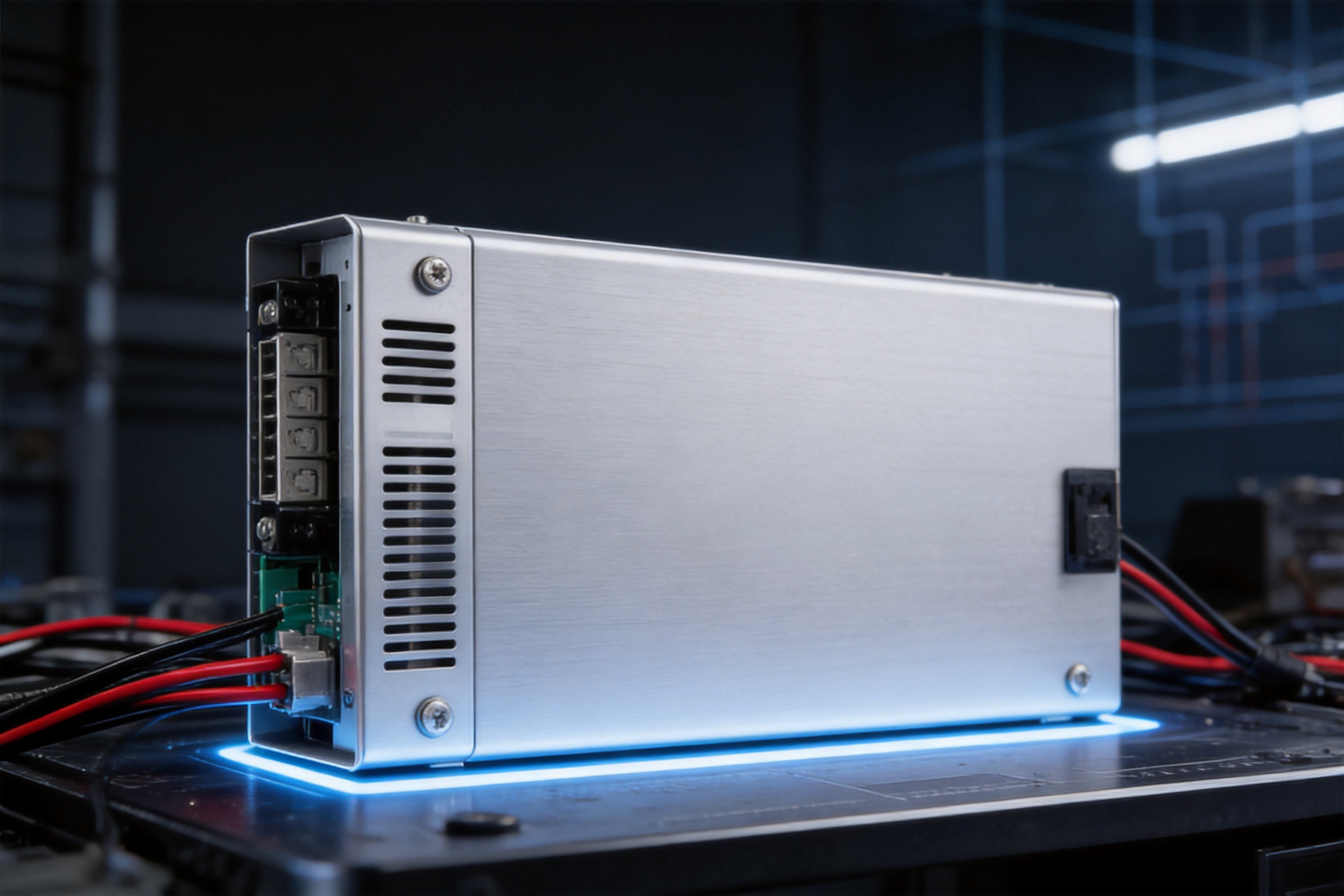
Universal Input Range for Flexible Deployment
The 90–264Vac input range is one of the product’s most useful features for international and industrial deployment. Electrical networks vary by country, facility, and application. A supply that accepts a broad input range can reduce the need for regional variants and simplify procurement for manufacturers serving multiple markets.
Universal input capability also provides flexibility within industrial facilities. Mains voltage may vary according to the building distribution system, local loading, transformer configuration, or generator operation. Although every system must remain within the specified operating range, accepting a broad range gives equipment designers more freedom when planning installations.
The 47–63Hz frequency range covers the most common commercial and industrial AC frequencies. This helps the same model serve equipment used in regions based on either 50Hz or 60Hz systems. For original equipment manufacturers, this can reduce the number of approved components that must be maintained in production and service inventories.
From a system integration perspective, a universal input supply can also shorten project preparation. Engineers do not have to begin with separate input versions for every export destination. Instead, they can evaluate one electrical platform and then confirm the final installation requirements, local regulations, and protective devices.
Power Factor Above 0.95
The T30-500W specifies a power factor greater than 0.95. Power factor describes how effectively an AC load uses the electrical power supplied to it. A higher power factor generally means that the equipment draws current in a way that is more favorable to the upstream electrical system than a low-power-factor load.
For industrial facilities with many electronic loads, power factor can influence current distribution, infrastructure utilization, and overall electrical planning. A power supply with a power factor above 0.95 can help reduce unnecessary reactive or distortion-related loading compared with less optimized designs. This may be especially relevant in equipment groups containing numerous LED fixtures, control cabinets, or switching power supplies.
High power factor does not eliminate the need for proper facility design. Cable sizing, circuit protection, grounding, ventilation, and load balancing must still be addressed by qualified professionals. However, it is a valuable product characteristic because it supports more efficient use of the AC input and aligns with the expectations of modern industrial equipment.
For manufacturers, power factor performance can also strengthen the technical profile of an end product. A machine or lighting system that uses a well-designed power source may be easier to position as an efficient and professionally engineered solution. This is particularly relevant in commercial and industrial projects where electrical performance is part of the procurement evaluation.
Surge Protection for Real-World Electrical Conditions
Industrial power networks may be affected by switching events, inductive loads, long cable runs, lightning-related disturbances, and differences in grounding conditions. These events can expose electronic equipment to short-duration voltage transients. Even when a disturbance does not immediately destroy a component, repeated stress can reduce operating life and increase the probability of intermittent faults.
The T30-500W specifies common-mode surge protection of 4KV and differential-mode surge protection of 2KV. Common-mode disturbances occur between conductors and ground, while differential-mode disturbances occur between conductors. Both types may appear in practical installations, and addressing them is important for equipment that operates in electrically active environments.
Common-mode protection can be particularly relevant where equipment is installed in large facilities, metal structures, outdoor enclosures, or systems with long AC or DC cable paths. Differential-mode protection helps address transient energy that appears across the input conductors. The specified ratings indicate that the power supply has been designed with attention to these two categories of electrical stress.
Surge protection should be considered part of a complete protection strategy rather than a substitute for external protective equipment. System designers may still need suitable breakers, fuses, grounding, surge protective devices, filtering, shielding, and installation practices based on the site conditions. Nevertheless, integrating meaningful protection into the power supply itself improves the resilience of the overall system.
Controlled Ripple for Sensitive Loads
Ripple is the residual periodic variation that remains on a DC output after AC-to-DC conversion and filtering. Excessive ripple can affect sensitive electronics, create visible light modulation in some LED systems, and contribute to noise in control or communication circuits. The T30-500W lists a ripple peak-to-peak value of 200mV.
A 200mV peak-to-peak specification provides an important reference for engineers evaluating the suitability of the supply. The actual effect of ripple depends on the connected equipment, the wiring arrangement, the measurement method, and the operating load. For this reason, system designers should review the requirements of sensitive devices and conduct application-level testing when necessary.
Controlled ripple is advantageous in industrial control systems because it helps create a cleaner DC bus for controllers, relays, sensors, and interface components. In LED applications, reduced output disturbance can support more uniform operation. It may also help reduce the risk that the power source contributes to unwanted electrical noise within the system.
Good installation practice remains essential. Output cable length, conductor size, terminal quality, grounding, load distribution, and separation between power and signal wiring can all influence actual system performance. A well-specified power supply provides a strong starting point, while correct integration ensures that the benefits are preserved in the finished installation.
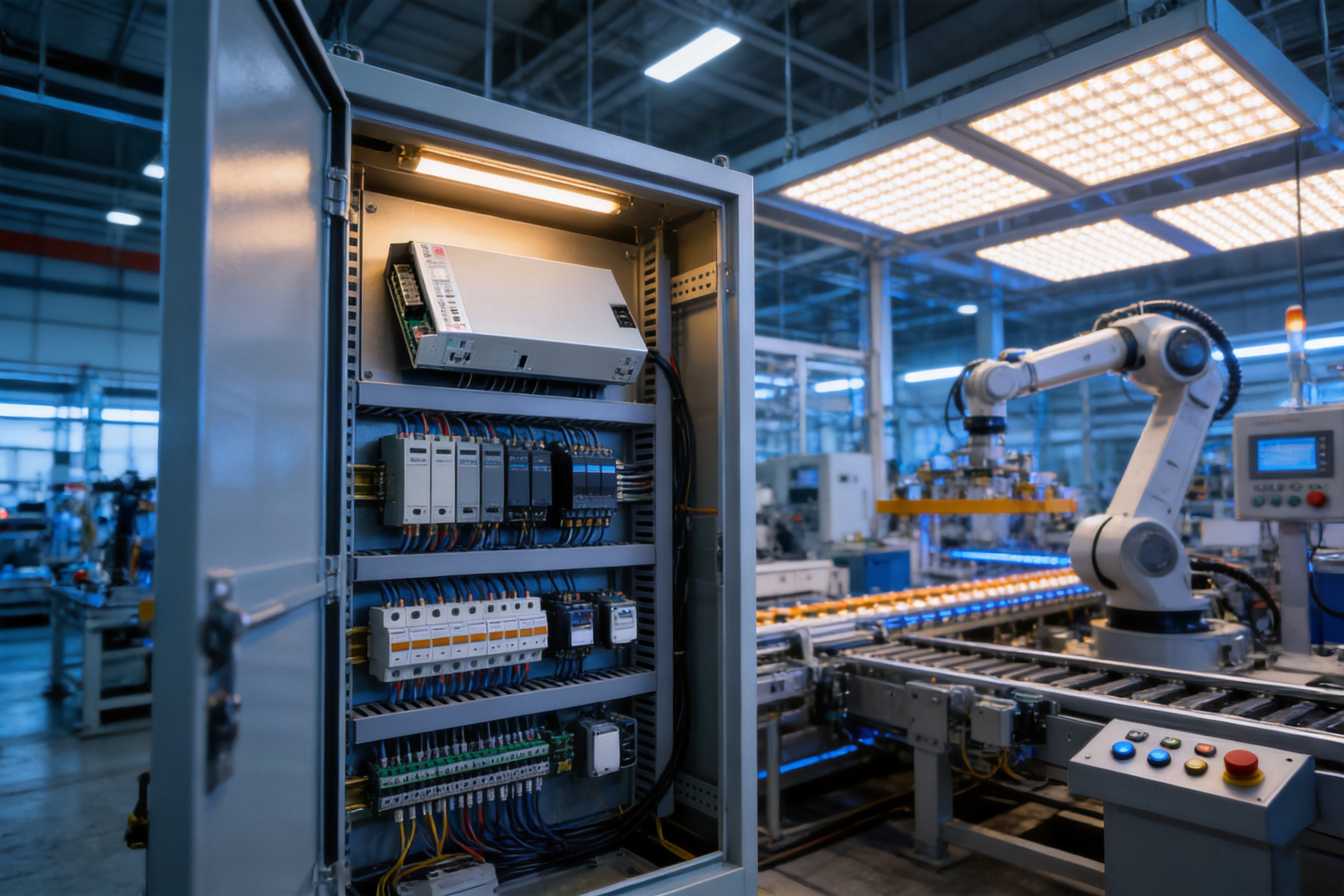
Compact Mechanical Format for Easier Integration
The enclosure dimensions are 230*127*40 mm. This relatively slim 40mm height can be helpful when the power supply must be installed inside a compact control cabinet, commercial equipment housing, or lighting system enclosure. Space in industrial equipment is often limited by mounting rails, wiring channels, heat dissipation requirements, and the physical dimensions of other components.
A compact form factor can reduce the need to enlarge an enclosure or redesign a mounting plate. It can also allow a power supply to be positioned near the load, helping control DC cable length and voltage drop. The final mounting arrangement must still allow adequate airflow and comply with the manufacturer’s installation instructions and the requirements of the complete system.
Mechanical integration should be evaluated together with electrical capacity. The available installation space, terminal orientation, cable bending radius, access for maintenance, and surrounding heat sources all influence the real-world suitability of a power supply. The T30-500W gives designers a defined physical envelope that can be incorporated into equipment layouts at an early stage.
For OEM production, consistent dimensions are important because they support repeatable assembly. A stable enclosure format can simplify tooling, mounting bracket design, wiring plans, and replacement procedures. It also helps service teams identify a compatible replacement without making major changes to the host equipment.
Certification Profile and Market Readiness
The product is listed with CB, CE, UKCA, UL, and FCC certifications. These marks and certification systems are relevant to international product development, although the exact scope and applicable standards should always be verified for the final product configuration and target market.
CB recognition is useful for international electrical product evaluation because it can support the transfer of test results among participating certification bodies. CE marking is associated with applicable European Union conformity requirements, while UKCA relates to the relevant conformity framework for Great Britain. UL recognition is widely valued in North American industrial and commercial markets. FCC requirements are associated with electromagnetic compatibility and unintentional emissions in the United States.
For equipment manufacturers, a broad certification profile may reduce the amount of additional evaluation required during product development. It can also support customer confidence during technical review. Project purchasers often prefer components with established compliance documentation because it makes internal approval, risk assessment, and market entry more manageable.
Certification does not replace responsible system engineering. The final assembled machine, luminaire, control cabinet, or commercial device may require its own testing and conformity assessment. Even so, starting with a power supply that has a strong certification profile can simplify the compliance pathway and reduce uncertainty during project planning.
Advantages Compared with Ordinary High-Current Alternatives
The T30-500W offers several practical advantages over basic or less comprehensively specified high-current power supplies. The first is the combination of output capacity and compact dimensions. Some high-current supplies require larger housings or multiple modules, while this model provides 24V/21A output in a 230*127*40 mm format.
The second advantage is the universal AC input range. A narrowly rated supply may need separate versions for different markets or facility voltages. The 90–264Vac range supports a more flexible product strategy and can reduce variant management for international manufacturers.
The third advantage is the combination of high power factor and defined surge protection. A product that offers current capacity alone may not provide the same level of attention to input behavior and electrical disturbance tolerance. The T30-500W combines a power factor greater than 0.95 with 4KV common-mode and 2KV differential-mode surge protection.
The fourth advantage is the published ripple specification. Engineers can compare the 200mV peak-to-peak value with the requirements of their connected equipment. Clear technical information is important because it allows decisions to be based on measurable parameters rather than only on a nominal wattage label.
Finally, the certification list supports broader market use. Products intended only for a limited local market may have fewer documented approvals. A supply with CB, CE, UKCA, UL, and FCC credentials is better positioned for equipment manufacturers that sell across regions, provided the final application meets all applicable requirements.
Applications in Automation Machinery
Automation machinery often contains multiple 24V devices, including programmable controllers, remote input and output modules, sensors, switches, relays, valves, human-machine interfaces, and industrial communication equipment. When these components operate together, the total current can become significant. A 21A supply provides useful capacity for centralized machine control architectures.
In a machine control cabinet, the supply may feed a DC distribution system that is divided into branches. Each branch can be protected and monitored according to the load. This approach helps organize wiring and allows maintenance personnel to identify the source of a fault more efficiently. The power supply should be selected with sufficient margin for startup current, future expansion, and the environmental conditions inside the cabinet.
Automation equipment may also experience disturbances from motors, solenoids, contactors, and variable-frequency drives. The T30-500W’s surge protection specifications are therefore relevant when it is integrated into an electrically active machine. Additional suppression devices may be required at inductive loads, but a protected power source contributes to a more robust architecture.
For machine builders, the product can support a common 24V platform across several equipment models. Standardization may simplify procurement, spare parts, wiring documentation, and technician training. A manufacturer can also use the same supply family in different machine configurations, provided that the load and thermal conditions remain within the design limits.
Applications in Industrial Control Systems
Industrial control systems require dependable DC power for monitoring, logic, signaling, and communication. A power interruption of only a short duration can cause a controller to reboot, interrupt a process, or require manual intervention. Stable conversion and suitable surge resistance are therefore important considerations during system design.
The T30-500W can be used as a central supply for control panels where multiple devices share a 24V bus. Its current rating is suitable for systems that exceed the capacity of small DIN-rail supplies but do not require a multi-kilowatt power architecture. The slim form factor can also make it easier to fit into equipment where panel depth and height are restricted.
Control system designers should calculate both normal and peak current. The nominal current draw of a controller may be low, but valves, relays, motors, or lighting loads connected to the same supply can create higher demand. A correctly selected high-current supply provides a more stable foundation than a unit operating continuously near its maximum rating.
Where uptime is critical, the supply may be used as part of a broader architecture involving redundancy, battery backup, monitoring, or separate branches for critical and noncritical loads. The T30-500W can provide the high-current conversion stage, while the system designer determines the appropriate redundancy and protection strategy.
Applications in Commercial Equipment
Commercial equipment may include display systems, access systems, vending equipment, professional appliances, building service equipment, and specialized electronic machines. These products often need to operate reliably in public or customer-facing environments, where a failure can affect service continuity and user experience.
The compact dimensions and international input range make the T30-500W suitable for equipment manufacturers that need to manage internal space and support multiple sales regions. Its 24V output can feed motors, control boards, LED lighting, fans, and other devices used in commercial equipment.
Commercial systems may also be installed in locations with variable maintenance capabilities. A clearly specified, certified power supply can simplify service documentation and reduce ambiguity when replacement or troubleshooting is required. The high-current design can support a complete equipment subsystem without forcing the manufacturer to use several unrelated power modules.
For commercial product developers, the power supply should be evaluated not only by output rating but also by acoustic behavior, heat generation, mounting method, accessibility, and enclosure ventilation. These factors influence the user’s experience and the equipment’s long-term reliability.
Applications in LED Installations
LED installations can involve long operating hours, large numbers of modules, and strict expectations for uniform brightness. Architectural lighting, commercial displays, industrial luminaires, and other LED systems may require a substantial 24V DC source. The T30-500W is suited to applications in which the load is compatible with a regulated 24V supply and the total current is within the design limits.
A single high-current supply can reduce the number of individual sources in a lighting system. This may simplify the electrical layout and help maintain a consistent voltage across connected LED branches. Designers must still account for voltage drop, cable length, branch protection, load balancing, and the starting characteristics of the LED modules.
The 200mV peak-to-peak ripple specification gives lighting engineers a measurable basis for evaluating output quality. This is useful when the installation includes camera-visible lighting, precision illumination, or applications where flicker performance is important. Final flicker behavior depends on the complete LED driver and control architecture, so system testing remains necessary.
The supply’s broad input range is also useful for lighting manufacturers that export products. A luminaire or lighting control package can be designed around a power source that accommodates common global AC systems. The listed certifications may further support project submissions and customer approval, subject to the complete lighting product’s compliance requirements.
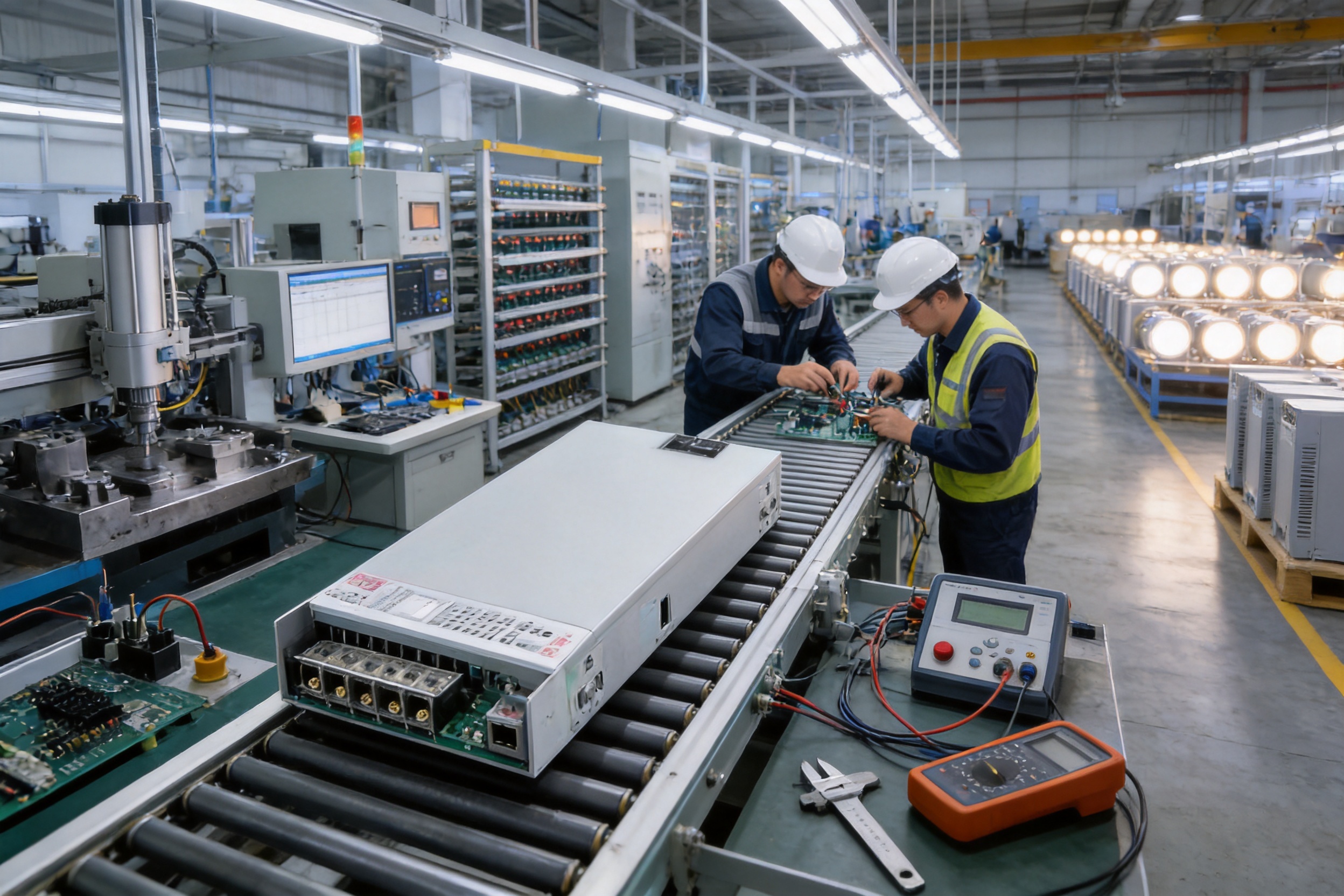
Manufacturing Strengths Behind the Product
The power supply is offered by Cixi HuaSheng Lighting Co., Ltd., a Ningbo-based manufacturer with experience in outdoor lighting, industrial lighting, solar lighting, explosion-proof lighting, and related electrical products. Although the T30-500W is a power supply rather than a lighting fixture, it benefits from a manufacturing organization that understands the requirements of industrial and commercial electrical equipment.
The company operates with die-casting and CNC machines, aging lines, and goniophotometers. These capabilities demonstrate an established production and testing environment for lighting hardware and related products. Die-casting and CNC machining support the manufacture of accurate metal components, brackets, housings, and structural parts. Aging lines help manufacturers evaluate product operation over controlled periods before shipment. Goniophotometers support photometric testing for lighting products and reflect the company’s broader emphasis on measurable performance.
Manufacturing capability is important when customers need more than a standard catalog item. Equipment builders may require customized housings, mounting arrangements, output configurations, labels, packaging, or integration support. A company with internal production resources and engineering experience is better positioned to coordinate these requirements than a trading organization that relies entirely on disconnected suppliers.
The company’s product range includes LED street lights, tunnel lights, high-bay lights, linear lights, garden lights, solar lights, grow lights, explosion-proof lights, and other lighting products. This range exposes the manufacturer to diverse environmental, optical, thermal, mechanical, and electrical requirements. Such experience can be valuable when a power supply is used in a lighting system that must function reliably in industrial or outdoor conditions.
Quality Management and Production Control
Cixi HuaSheng Lighting Co., Ltd. is identified as holding ISO 9001, ISO 14001, and ISO 45001 certifications. These standards represent different aspects of organizational management. ISO 9001 is associated with quality management, ISO 14001 with environmental management, and ISO 45001 with occupational health and safety management.
A quality management system can help establish repeatable procedures for incoming materials, production operations, inspection, corrective action, documentation, and customer feedback. For a power supply, repeatability is essential because small variations in assembly, soldering, insulation, mechanical fit, or testing can affect field performance.
Environmental management is increasingly relevant to industrial customers. Buyers may evaluate not only the performance of an electrical component but also the supplier’s approach to material use, waste control, energy management, and environmental responsibility. ISO 14001 certification indicates that the manufacturer has a structured framework for managing these concerns.
Occupational health and safety management supports responsible factory operations. A safer production environment can contribute to more stable manufacturing practices and better long-term organizational performance. Together, the three management certifications present a broader picture of the manufacturer’s operating discipline.
Certifications alone cannot guarantee the result of every individual product. However, they provide evidence that the organization has formal management processes and that these processes are subject to external assessment. Customers should still request current certificates, technical datasheets, inspection records, and application-specific documentation during qualification.
Engineering Support and Customization Capability
Industrial customers often need assistance at several stages, from initial selection to final installation. The company provides one-stop services that include efficient lighting solutions, DIALux designs, mold design, OEM and ODM development, SKD and CKD customization, and delivery coordination. These services are especially relevant for customers developing complete lighting products or integrating power systems into larger assemblies.
OEM and ODM support can help customers create products under their own specifications or brand requirements. Depending on the project, customization may involve mechanical components, mounting structures, packaging, labels, electrical combinations, or production quantities. A supplier capable of coordinating these details can reduce the number of external parties involved in a project.
SKD and CKD options may support customers with regional assembly strategies. Semi-knocked-down and completely knocked-down arrangements can be used when local assembly, logistics, taxation, or market requirements influence the preferred supply chain. The exact scope of such services must be negotiated according to the product, local regulations, and production capability.
DIALux design services are mainly associated with lighting layouts, but they illustrate the company’s ability to support project-level planning rather than simply sell individual components. When the T30-500W is used in an LED installation, this broader project knowledge can help customers evaluate the relationship between lighting load, power distribution, fixture arrangement, and expected performance.
Customization should always be controlled through documented specifications. Customers should define input requirements, output characteristics, environmental conditions, connectors, mechanical constraints, certifications, labeling, packaging, and inspection criteria before mass production. Clear documentation helps ensure that engineering changes are understood by both parties.
Production and Testing Considerations
Power supply reliability begins with component selection and continues through assembly, inspection, aging, and final testing. High-current products require particular attention to conductive paths, thermal management, insulation distances, terminals, solder joints, and mechanical support. Each of these elements can influence voltage stability and long-term service life.
Production control should verify that the correct components are used and that assembly processes remain within defined parameters. Automated or semi-automated procedures can improve consistency, while trained inspection personnel can identify visible defects, incorrect connections, damaged parts, or mechanical problems.
Aging tests are useful because they operate products for a controlled period before shipment. This process can help reveal certain early-life failures or unstable behavior that may not appear during a short functional check. Aging is not a substitute for design validation, environmental testing, or application testing, but it is a valuable part of production quality control.
Final inspection should confirm key product characteristics such as input operation, output voltage, output current capability, protection behavior, insulation performance, appearance, dimensions, labels, and packaging. The specific inspection plan should reflect the applicable standards and customer requirements.
For customers purchasing in volume, supplier evaluation may include factory audits, sample approval, pilot production, first-article inspection, process documentation, and ongoing batch controls. These activities create a stronger connection between the published specification and the product delivered in quantity.
How to Select the Product for a Specific System
The first step is to calculate the total DC load. List every connected device, identify its nominal current, and account for startup or peak demand. Loads should not be estimated only from average operating power if motors, relays, valves, LED modules, or other devices draw a higher current during activation.
The second step is to determine the required operating margin. A supply that operates continuously at its maximum rating may have less tolerance for ambient temperature, blocked airflow, input variation, or future expansion. The appropriate margin depends on the equipment design, duty cycle, environment, and applicable engineering standards.
The third step is to evaluate the AC input conditions. Confirm that the facility voltage and frequency fall within the 90–264Vac and 47–63Hz ranges. If the installation has a generator, unstable utility supply, long feeder, or frequent switching events, additional input protection and power conditioning may be required.
The fourth step is to review mechanical integration. The 230*127*40 mm dimensions should be compared with the available mounting area, cable routes, ventilation paths, access requirements, and nearby heat sources. The product must be installed in a way that prevents excessive temperature rise and allows appropriate maintenance.
The fifth step is to evaluate compliance. Confirm that the listed CB, CE, UKCA, UL, and FCC certifications are applicable to the intended market and product configuration. The complete machine or lighting system may require additional certification, EMC testing, safety testing, or declaration procedures.
Installation Best Practices
Use conductors with a current rating appropriate for the 21A output and the expected installation conditions. Cable selection should consider length, ambient temperature, bundling, allowable voltage drop, insulation rating, and local electrical codes. Undersized conductors can create heat, voltage loss, and unnecessary stress on the system.
Separate power wiring from sensitive signal and communication wiring where practical. Good routing can reduce the possibility of unwanted coupling and make troubleshooting easier. Connections should be properly tightened and protected from vibration, contamination, and accidental contact.
Provide adequate ventilation around the power supply. Do not cover ventilation openings or position the unit next to a high-temperature component without evaluating the thermal impact. Enclosures should be designed to prevent heat accumulation, especially when several power devices operate together.
Use suitable upstream protection, including fuses or circuit breakers selected for the installation. If the equipment is exposed to lightning, long outdoor cables, or severe switching transients, consider a coordinated surge protection system. The internal surge protection specification is beneficial, but complete site protection depends on the entire electrical architecture.
Before connecting the final load, verify polarity, wiring integrity, grounding, and output voltage. After commissioning, observe the system under normal and peak conditions. Check for unusual heating, audible noise, voltage drop, flicker, resets, or other symptoms that might indicate an integration problem.
Maintenance and Long-Term Reliability
Routine maintenance should include visual inspection, terminal checks, ventilation review, and verification that dust, moisture, or other contamination has not accumulated around the supply. The schedule depends on the environment. Equipment installed in clean indoor areas may require less frequent attention than equipment installed in factories, workshops, outdoor cabinets, or dusty commercial spaces.
Monitor the system for changes in behavior. Repeated controller resets, unexplained LED brightness variation, increased temperature, unusual odor, or damaged wiring should be investigated promptly. Such symptoms may result from the load, the installation, the surrounding environment, or the power supply itself.
Maintain accurate records of the model, installation date, operating conditions, inspection results, and replacement history. The model number MS-TB100J240-500C0 should be recorded in equipment documentation so that service teams can identify the correct product quickly.
Where continuous operation is essential, customers may keep a qualified replacement unit in inventory. A standardized 24V/21A supply can simplify spare-parts planning when it is used across multiple equipment models. Replacement procedures must always follow electrical safety rules and confirm that the new unit matches the original application requirements.
Value for OEMs, Integrators, and Project Contractors
For OEMs, the T30-500W provides a defined electrical platform that can be incorporated into new machines, lighting products, and commercial equipment. Its universal input range supports international product development, while its compact size helps preserve space for other components.
For system integrators, the product combines several features that are often evaluated separately: current capacity, power quality, surge protection, power factor, certifications, and dimensions. Having these characteristics in one unit can simplify technical comparisons and reduce the number of alternatives that must be evaluated during a project.
For project contractors, a clearly documented 500W-class supply can make procurement and installation planning more predictable. The 24V/21A output provides a straightforward basis for load calculations, while the protection and certification information supports project approval discussions.
For lighting manufacturers, the company’s broader manufacturing capabilities can provide access to related fixtures, housings, molds, optical design support, and customized production services. This may be beneficial when the power supply is part of a larger product development program rather than a standalone purchase.
Q&A
What is the output of the T30-500W power supply?
The power supply provides a nominal output of 24V at 21A. It is identified as a 500W-class unit and is intended for high-current industrial, commercial, automation, control, and LED applications.
What input voltage can the product accept?
The specified input range is 90–264Vac at 47–63Hz. This broad range supports common electrical systems in different regions, including both 50Hz and 60Hz networks.
What does a 21A output mean for system design?
A 21A output allows the supply to support a larger combined 24V load than many small industrial supplies. Engineers should calculate normal and peak current, include an appropriate design margin, and confirm thermal and installation conditions before using the product at a specific load.
Is the power supply suitable for LED installations?
It can be suitable for LED installations that require a regulated 24V source and whose total current remains within the product’s design limits. Designers must also evaluate cable voltage drop, branch protection, LED module requirements, flicker behavior, ventilation, and the complete lighting system’s compliance.
What surge protection does it provide?
The listed surge protection rating is 4KV for common-mode disturbances and 2KV for differential-mode disturbances. External protection may still be required depending on the site, cable length, lightning exposure, and applicable installation standards.
What is the ripple specification?
The product lists 200mV peak-to-peak ripple. This gives engineers a measurable reference when evaluating the supply for control electronics, LED systems, and other applications that may be sensitive to DC output quality.
What is the power factor?
The specified power factor is greater than 0.95. This supports more effective use of AC input power compared with a low-power-factor design, although complete facility efficiency also depends on the wider electrical system.
What are the product dimensions?
The dimensions are 230*127*40 mm. The slim 40mm height can help with integration in control cabinets, commercial equipment, and compact lighting enclosures, subject to appropriate ventilation and mounting clearance.
Which certifications are listed for the product?
The listed certifications are CB, CE, UKCA, UL, and FCC. Customers should verify the current certification documents and confirm that they apply to the intended product configuration and destination market.
Can the product be used in an outdoor enclosure?
Use in an outdoor enclosure depends on the enclosure’s protection rating, temperature control, humidity management, condensation prevention, and the complete installation design. The power supply should not be exposed to conditions beyond its documented environmental limits.
Does the manufacturer provide customization services?
The manufacturer provides OEM and ODM services, mold design, SKD and CKD customization, lighting design support, and delivery coordination. Specific customization options, minimum quantities, documents, and production schedules should be confirmed for each project.
Why is the manufacturer suitable for lighting-related projects?
The manufacturer produces multiple categories of lighting products and operates die-casting, CNC, aging, and photometric testing resources. It also provides lighting solutions and DIALux design support, which can be useful when the power supply is integrated into a complete lighting project.
Can one supply be used for redundant systems?
The T30-500W can serve as a high-current conversion source within a larger system, but redundancy requires additional architecture, such as parallel operation equipment, redundant modules, monitoring, or separate backup supplies. The design must follow the requirements of the application and the relevant technical documentation.
Conclusion
The Reliable High Current Power Supply T30-500W is designed for industrial and commercial systems that need substantial 24V current in a practical package. Its 24V/21A output, 90–264Vac input range, 47–63Hz frequency compatibility, power factor above 0.95, 200mV peak-to-peak ripple, and defined common-mode and differential-mode surge protection provide a balanced set of specifications for demanding applications.
Compared with basic high-current alternatives, the product distinguishes itself through the combination of capacity, compact dimensions, international input flexibility, power quality, surge resistance, and a broad certification profile. These features can simplify integration into automation machinery, control systems, commercial equipment, and LED installations.
The product is supported by a manufacturer with experience in outdoor and industrial lighting, ISO 9001, ISO 14001, and ISO 45001 management certifications, and production resources including die-casting machines, CNC equipment, aging lines, and goniophotometers. Its OEM, ODM, mold design, SKD, CKD, and lighting design capabilities also make it suitable for customers seeking a broader manufacturing partner.
As with any industrial power component, correct selection and installation remain essential. Engineers should confirm load requirements, environmental conditions, ventilation, wiring, protection, certification scope, and applicable local regulations. When these factors are properly addressed, the T30-500W can provide a stable and adaptable power foundation for high-current equipment and integrated lighting systems.
References
1. Cixi HuaSheng Lighting Co., Ltd., product information for Reliable High Current Power Supply T30-500W, model MS-TB100J240-500C0.
2. Cixi HuaSheng Lighting Co., Ltd., company information and manufacturing capability statement.
3. International Electrotechnical Commission, general principles for power supply safety, electromagnetic compatibility, and electrical equipment evaluation.
4. ISO, ISO 9001 quality management system principles and requirements.
5. ISO, ISO 14001 environmental management system principles and requirements.
6. ISO, ISO 45001 occupational health and safety management system principles and requirements.
7. International Electrotechnical Commission, guidance on power quality, surge protection, conducted disturbances, and industrial electrical installations.
8. Relevant regional conformity assessment frameworks for CB, CE, UKCA, UL, and FCC requirements.
Product: Reliable High Current Power Supply T30-500W

Solusi Kustom & OEM untuk Merek Pencahayaan Global
Hak Cipta © Cixi HuaSheng Lighting Co., Ltd. Semua Hak Dilindungi Undang-undang.
Pemasok Cetakan Die-Casting
