 English
 中文简体
 русский
 Français
 Español
 عربى
 Indonesia

Decorative Garden Light Phantom Star: Modern Outdoor Illumination for Contemporary Landscapes
Outdoor lighting has become an essential part of modern architectural and landscape design. A well-designed garden light does much more than illuminate a pathway after sunset. It defines visual boundaries, improves pedestrian comfort, enhances the appearance of buildings and planting areas, and contributes to the identity of residential, commercial, and public spaces. For these applications, lighting equipment must combine attractive styling, reliable performance, weather resistance, optical quality, and efficient installation.
The Decorative Garden Light Phantom Star is a contemporary outdoor lighting solution developed for gardens, courtyards, villas, hotels, residential communities, and landscape projects. With its distinctive modern appearance, durable aluminum construction, controlled light distribution, and IP66/IK08 protection, it is designed to provide dependable illumination while complementing sophisticated outdoor environments.
This product is particularly suitable for customers seeking an alternative to conventional garden lamps that may appear visually outdated, provide uneven illumination, or require frequent maintenance. Its combination of a modern lamp head, robust materials, high-efficiency LED technology, and customization capabilities gives landscape designers, contractors, developers, and lighting distributors greater flexibility when planning outdoor lighting systems.
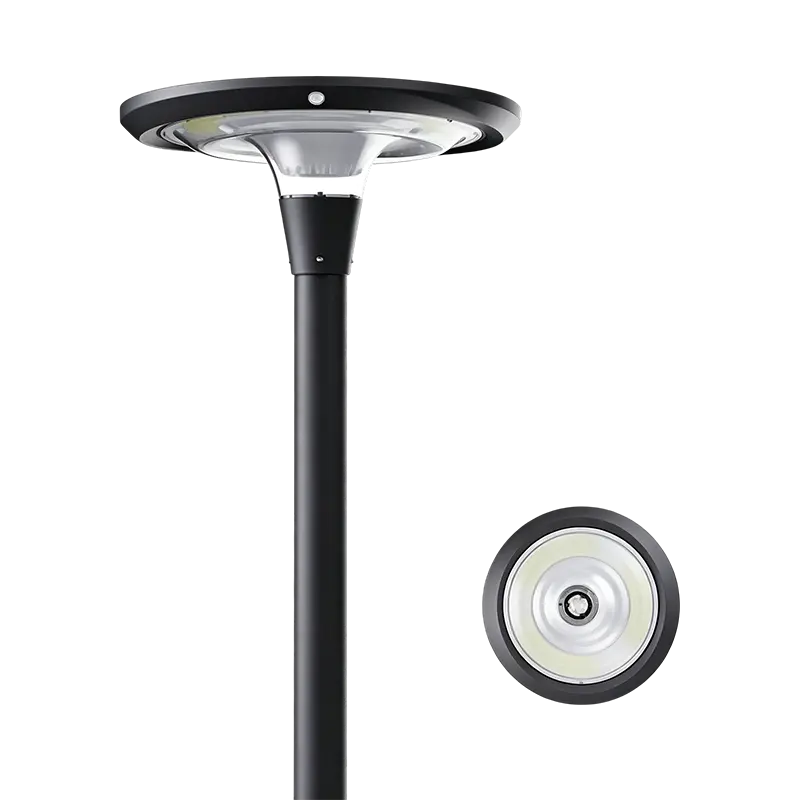
Decorative Garden Light Phantom Star
1. Product Overview
The Phantom Star is a decorative garden light identified by the product model GG-AC-ZN. It is designed as a contemporary outdoor lamp for spaces where appearance and performance are equally important. Rather than functioning as a simple utility light, it forms part of the overall landscape composition. Its structure and proportions are intended to work with modern architectural lines, landscaped walkways, courtyard features, planted areas, and outdoor gathering spaces.
The light is designed to deliver soft and even illumination. This makes it appropriate for environments where strong glare or harsh shadows would reduce visual comfort. Garden paths, entrances, outdoor seating areas, hotel grounds, and villa landscaping can benefit from a light source that improves visibility without overwhelming the surrounding architecture or vegetation.
Its 50W input wattage provides a practical balance between illumination output and energy consumption. The stated light effect is 100–160 lm/W ±5%, depending on the selected lighting configuration and operating conditions. This efficiency range enables project planners to achieve useful illumination while controlling electrical demand in comparison with older, less efficient outdoor lighting technologies.
The product operates within an AC 100–305V input voltage range. This broad voltage range supports use in different electrical environments and helps provide flexibility for international projects. The IP66 protection grade protects the fixture against dust ingress and powerful water jets, while the IK08 impact rating indicates a strong level of resistance to mechanical impact in normal outdoor applications.
Key Product Specifications
| Specification | Value |
|---|---|
| Product model | GG-AC-ZN |
| Product name | Phantom Star |
| Application category | LED Garden Light |
| Input wattage | 50W |
| Light effect | 100–160 lm/W ±5% |
| Input voltage | AC 100–305V |
| Protection grade | IP66 |
| Impact resistance | IK08 |
| Product size | Diameter 576 mm × 240 mm |
| Primary structural materials | Aluminum pole, die-cast aluminum lamp head |
| Optical diffuser options | PC, PMMA, or PS |
| Fastener material | 304 stainless steel screws |
2. Contemporary Design for High-Visibility Outdoor Spaces
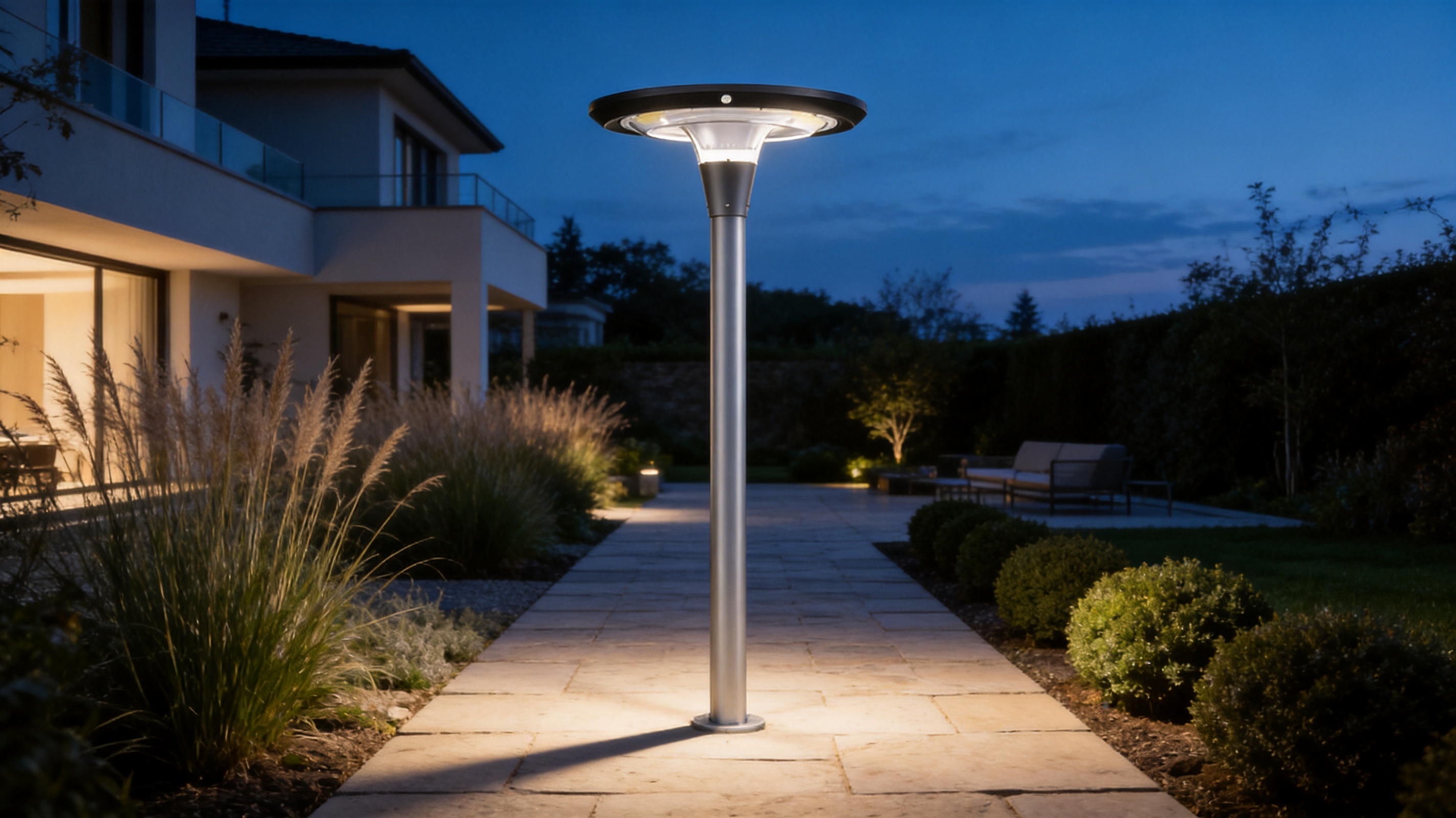
One of the most important advantages of a decorative garden light is its ability to remain visually attractive during both daytime and nighttime. Many outdoor luminaires are installed in prominent areas, meaning that their unlit appearance can influence the perceived quality of an entire property. The Phantom Star addresses this requirement with a modern form intended for contemporary gardens and architectural surroundings.
The 576 mm diameter and 240 mm height create a noticeable but balanced visual presence. This scale allows the fixture to function as a design element without becoming unnecessarily dominant. It can be integrated into landscape schemes featuring stone paving, planting beds, water features, modern façades, and outdoor seating. Its form can also support repeated installation along paths or within larger courtyards, where consistency between individual fixtures is important.
Compared with basic garden lights that often rely on generic cylindrical or traditional decorative shapes, the Phantom Star offers a more distinctive visual identity. This can be valuable for hotels, residential developments, commercial courtyards, and landscape projects that need to communicate a contemporary design language. A coordinated lighting appearance can help make an entrance, public plaza, or garden environment appear more intentional and professionally designed.
The modern styling also supports OEM and ODM development. Customers can request adjustments to the appearance, color, and lighting performance to align the product with a project’s architectural concept or a distributor’s product range. This flexibility is especially useful for lighting brands, construction companies, landscape contractors, and property developers that require a customized appearance rather than an off-the-shelf fixture.
3. Durable Materials for Outdoor Reliability
Aluminum Structural Components
The structure uses aluminum poles and a die-cast aluminum lamp head. Aluminum is widely used in professional outdoor lighting because it offers a useful combination of low weight, mechanical strength, and corrosion resistance. A lighter structure can simplify transportation, handling, and installation, while the material’s strength helps the luminaire maintain its shape during long-term outdoor use.
The die-cast aluminum lamp head is particularly important because it provides a stable enclosure for the optical and electrical components. Die casting allows manufacturers to produce consistent forms with controlled dimensions and integrated structural features. This supports repeatable assembly and helps create a precise interface between the lamp head, diffuser, seals, and mounting elements.
For outdoor applications, aluminum surfaces require suitable protection against environmental exposure. The Phantom Star uses an anti-corrosion powder coating on its aluminum poles. Powder coating creates a durable finish that helps protect the substrate from moisture, oxidation, and everyday abrasion. It also enables color customization, allowing the fixture to coordinate with façades, landscape furniture, poles, fences, and other outdoor elements.
304 Stainless Steel Screws
The use of 304 stainless steel screws is another detail that supports long-term outdoor performance. Fasteners are often exposed to moisture, temperature changes, and airborne contaminants. If unsuitable screws are used, rust staining or seized fasteners can affect both appearance and future maintenance.
304 stainless steel is a widely used material for outdoor hardware because of its resistance to corrosion in many general environmental conditions. It helps preserve the integrity of the assembly and supports easier service access when inspection or component replacement is required. The selection of stainless steel fasteners demonstrates an attention to small but important construction details that can influence the life cycle of an outdoor fixture.
4. Optical Performance and Visual Comfort
Good outdoor lighting is not defined only by brightness. The quality of light distribution is equally important. A fixture that produces excessive glare, bright spots, or sharp patches of light may reduce comfort and create an unattractive appearance. The Phantom Star is designed to provide soft, even illumination, making it appropriate for garden and courtyard environments where people may walk, sit, socialize, or view the surrounding architecture.
The product can use optical diffusers made from PC, PMMA, or PS. These materials can be selected according to the required optical effect, appearance, durability, and project specification. A diffuser helps spread light across the intended area and reduces the visual intensity of the LED source. This creates a more comfortable light pattern than a completely exposed point source.
Polycarbonate, commonly known as PC, is valued for its impact resistance and practical outdoor performance. PMMA can provide strong optical clarity and a clean visual appearance. PS may be selected for particular design or cost requirements. The availability of these diffuser options gives manufacturers and customers greater control over the final balance between appearance, optical transmission, mechanical performance, and project budget.
The stated light effect of 100–160 lm/W ±5% indicates a high-efficiency LED configuration. Actual results may vary according to LED selection, color temperature, driver configuration, optical diffuser, ambient temperature, and operating conditions. Nevertheless, the efficiency range provides a strong basis for designing outdoor lighting systems with useful illumination and controlled energy consumption.
For landscape designers, evenly distributed light can improve the appearance of paving, planting, walls, and architectural surfaces. For property owners, it can help create a calmer and more comfortable nighttime environment. For facility managers, efficient light output can contribute to lower operating costs and support broader energy-management objectives.
5. Protection Against Weather and Impact
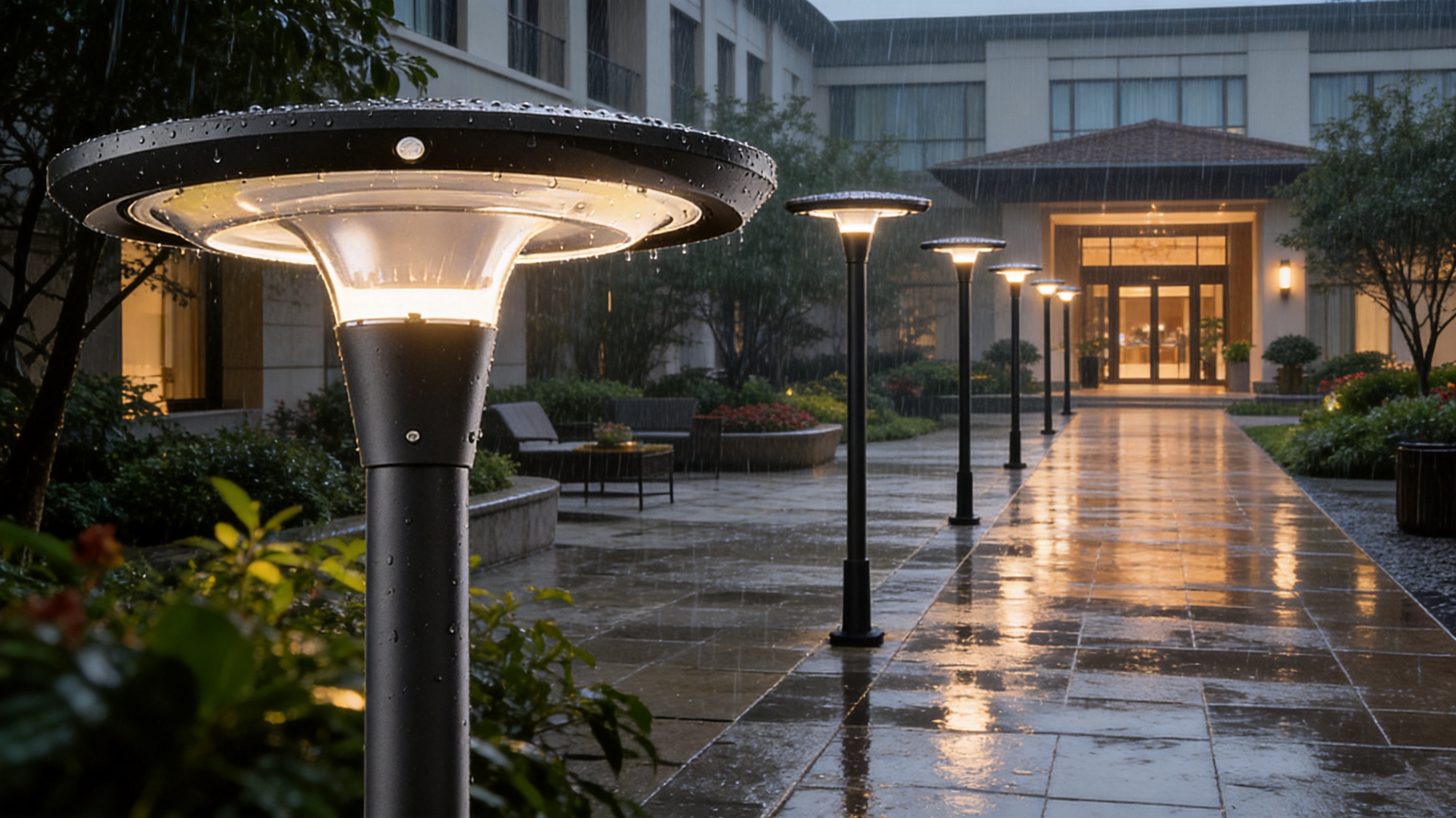
Outdoor garden lights must operate through changing weather conditions, including rain, wind-driven water, dust, humidity, and seasonal temperature changes. The Phantom Star has an IP66 protection grade, which is appropriate for demanding outdoor environments when the product is installed and maintained according to the manufacturer’s instructions.
The first digit of the IP rating indicates protection against solid particles. The “6” signifies a dust-tight enclosure. This is beneficial in gardens, construction areas, roadside landscapes, and industrial or semi-industrial surroundings where airborne particles may accumulate on equipment.
The second digit, also “6,” indicates protection against powerful water jets. This does not mean that every installation condition is identical, and correct mounting, cable entry, sealing, and drainage remain essential. However, the rating provides a strong level of enclosure protection for exposed outdoor applications and helps reduce the risk of water-related damage when the fixture is properly installed.
The IK08 impact rating indicates resistance to mechanical impact. Garden luminaires may be exposed to accidental contact from maintenance equipment, recreational activity, transported materials, or other routine incidents. A robust impact rating helps reduce the likelihood that minor impacts will damage the enclosure or diffuser.
Compared with decorative fixtures designed mainly for appearance, the Phantom Star offers a more balanced approach. It combines modern styling with enclosure protection and structural durability. This makes it suitable for projects where the lighting must remain attractive while also meeting practical requirements for outdoor service.
6. Applications in Residential and Commercial Landscapes
Residential Communities
Residential communities require lighting that improves safety and orientation while preserving a welcoming atmosphere. The Phantom Star can be used along internal roads, pedestrian routes, entrances, common gardens, and shared courtyards. Its soft illumination can help residents navigate outdoor spaces without creating an excessively bright or institutional appearance.
In higher-end residential developments, the design of lighting equipment is part of the project’s overall visual quality. A contemporary garden light can support a consistent design language across building façades, landscape furniture, paving materials, and planting. The fixture can also be specified in a customized color to match the development’s architectural palette.
Villas and Private Gardens
Private villas often combine architectural surfaces, garden areas, driveways, patios, pools, and outdoor entertainment zones. Lighting must be functional but should not distract from the property’s design. The Phantom Star can be positioned near entrances, garden paths, terraces, and planted features to create layers of illumination around the property.
Its decorative appearance allows the fixture to remain visually appropriate during daylight hours. This is an important advantage for private properties where garden lights may be located close to windows, patios, or major architectural viewpoints.
Hotels and Hospitality Projects
Hotels use outdoor lighting to shape the guest experience. Arrival areas, courtyards, gardens, restaurants, pools, and pedestrian routes all require different levels of illumination and different visual moods. A modern garden light can contribute to a refined and coordinated atmosphere, particularly when installed in repeated groups throughout a property.
Hotels also benefit from durable products that reduce maintenance interruptions. The combination of aluminum construction, powder coating, stainless steel fasteners, IP66 protection, and efficient LED performance supports the operational requirements of hospitality environments.
Landscape and Municipal Projects
Landscape contractors and municipal planners often need products that can be used in large quantities and maintained over a long service period. Consistent production quality is important because variations in dimensions, color, light output, or assembly may become noticeable across a large installation.
The Phantom Star is manufactured using controlled metal-processing, coating, optical, assembly, and testing capabilities. These resources support repeatable production for projects that require multiple fixtures. Its broad AC 100–305V input range can also make it suitable for international project specifications, subject to local electrical requirements and certification needs.
7. Advantages Compared with Conventional Garden Lights
The Phantom Star offers several advantages over basic or outdated outdoor garden lighting products. The first is design differentiation. Conventional fixtures may use generic shapes that provide little contribution to the visual character of a landscape. The Phantom Star is intended to function as a contemporary design feature, helping projects achieve a more coherent and modern appearance.
The second advantage is the combination of decorative styling and protective performance. Some decorative luminaires prioritize appearance but provide limited resistance to dust, water, or impact. With IP66 and IK08 ratings, the Phantom Star is designed to meet more demanding outdoor conditions while retaining its visual appeal.
The third advantage is construction quality. Aluminum poles, a die-cast aluminum lamp head, powder coating, optical diffusers, and 304 stainless steel screws create a more complete product solution than fixtures assembled with low-grade materials. Each component contributes to service life, appearance retention, or installation reliability.
The fourth advantage is optical comfort. A soft and even light output is often more appropriate for gardens and courtyards than intense, uncontrolled illumination. The use of PC, PMMA, or PS optical diffusers helps manage the appearance of the LED source and supports a smoother distribution of light.
The fifth advantage is energy efficiency. A light effect of 100–160 lm/W ±5% can help reduce the wattage required for a target illumination level compared with less efficient LED products or traditional light sources. Lower energy use can reduce operating expenses, particularly in projects with many fixtures or long nightly operating schedules.
The sixth advantage is customization. OEM and ODM services can include modern styling, color customization, and lighting performance adjustment. This allows customers to develop a product that better reflects a specific brand identity, architectural project, or regional market preference.
| Comparison Area | Conventional Basic Garden Light | Phantom Star Approach |
|---|---|---|
| Visual design | Often generic or traditional | Contemporary decorative styling |
| Light distribution | May be uneven or visually harsh | Soft, even illumination using optical diffusers |
| Structural materials | May use mixed or lower-grade materials | Aluminum structure and die-cast aluminum lamp head |
| Fasteners | Material may vary by supplier | 304 stainless steel screws |
| Weather resistance | Protection level may be limited | IP66 protection grade |
| Impact resistance | May not be clearly specified | IK08 impact rating |
| Efficiency | May offer lower light output per watt | 100–160 lm/W ±5% stated light effect |
| Customization | Often restricted to standard versions | OEM/ODM styling, color, and performance options |
8. Advanced Manufacturing Capabilities
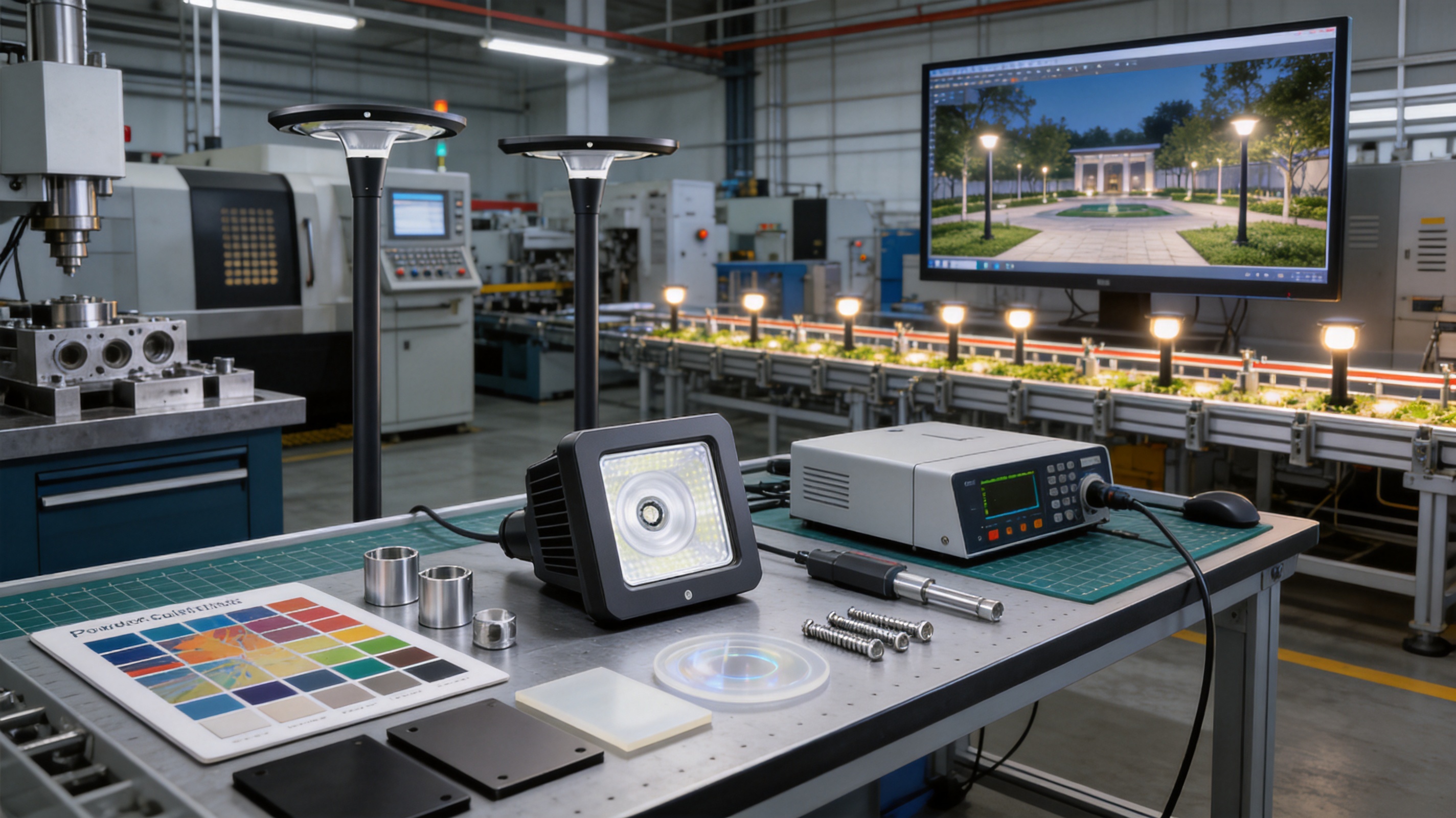
Product performance depends not only on the design concept but also on the manufacturing system used to produce the fixture. The manufacturer behind the Phantom Star operates as a professional outdoor lighting producer in Ningbo, China, with experience in lighting solutions for global customers. Its product range includes street lights, tunnel lights, high-bay lights, linear lights, garden lights, solar lights, grow lights, and explosion-proof lights.
This broad product experience is valuable because different lighting categories require different knowledge of optics, thermal management, sealing, electrical design, materials, and compliance. Experience across multiple product families can support a more integrated approach to developing and manufacturing outdoor luminaires.
Die-Casting and CNC Machining
Die-casting equipment supports the production of consistent aluminum lamp heads and other metal components. Accurate die-casting can improve dimensional repeatability, surface quality, and assembly compatibility. It also allows the development of complex shapes that would be difficult or inefficient to produce through simple sheet-metal fabrication.
CNC machines provide controlled machining for precision features such as mounting surfaces, connection points, threaded holes, and component interfaces. CNC processing is important when components must fit together accurately and when a project requires repeatable production across many units.
The combined use of die-casting and CNC machining can help create a reliable foundation for the Phantom Star’s enclosure. It supports the modern appearance of the lamp head while also contributing to assembly quality and structural stability.
Powder-Coating Processes
Powder coating is used to protect the aluminum poles and provide a consistent exterior finish. A controlled coating process helps improve adhesion, color consistency, surface durability, and resistance to ordinary outdoor exposure. For OEM and ODM projects, powder coating also provides a practical method for developing customized colors.
Color control is particularly important when a garden light is installed in a carefully planned landscape. A mismatch between lighting poles, architectural metalwork, and outdoor furniture can reduce the perceived quality of the project. Consistent coating production helps customers maintain a more coordinated visual result.
Aging and Reliability Lines
The manufacturer operates aging lines for lighting products. Aging is an important production-stage procedure used to operate fixtures for a controlled period before shipment. This process can help identify certain early-stage electrical or assembly issues and provides an additional quality-control step beyond visual inspection alone.
For customers purchasing lighting in project quantities, production testing can reduce uncertainty. It helps support consistent operation from the first installation and contributes to a more reliable supply process for distributors, contractors, and developers.
Photometric Testing
Goniophotometers are used to evaluate the photometric performance of lighting products. Such equipment can measure light distribution, intensity, efficiency, and related optical characteristics. Photometric data is essential for professional lighting design because it supports accurate spacing, mounting-height decisions, illumination calculations, and DIALux or similar simulations.
The availability of goniophotometric testing is a significant strength for a manufacturer of outdoor luminaires. It indicates that product development and quality control can be supported by measured optical data rather than relying exclusively on visual judgment. This is especially useful for projects that require documented light distribution or carefully calculated illumination levels.
9. Quality Management and Certification Strengths
The manufacturer is certified to ISO 9001, ISO 14001, and ISO 45001. These standards represent important areas of organizational management. ISO 9001 relates to quality management systems, ISO 14001 addresses environmental management, and ISO 45001 focuses on occupational health and safety management.
A quality management system can support controlled procedures for purchasing, production, inspection, corrective action, and customer service. For a lighting buyer, this may contribute to more consistent product delivery and clearer handling of quality issues. It also provides a structured basis for continuous improvement.
Environmental management is increasingly important in the lighting industry. Customers and project owners are paying closer attention to material use, energy consumption, manufacturing impacts, packaging, and product life cycle. An environmental management framework can support more systematic consideration of these issues in manufacturing operations.
Occupational health and safety management is also relevant to production reliability. Safe and organized manufacturing conditions can help reduce operational disruptions and support stable production capacity. Together, the three management certifications demonstrate a broad approach to quality, environmental responsibility, and workplace safety.
Relevant lighting products are certified by CB and CE, depending on the specific product and configuration. Certification requirements should always be confirmed for the exact model, electrical version, market, and project specification. Nevertheless, the manufacturer’s experience with international compliance provides useful support for customers purchasing lighting for global applications.
10. OEM and ODM Customization
Lighting projects frequently require more than standard product selection. A developer may need a particular color to match a façade. A distributor may require its own product identity. An architectural project may demand a modified lamp head, a special light distribution, or a specific electrical configuration. The Phantom Star is offered with OEM and ODM support for these types of requirements.
Styling Customization
Modern styling can be adjusted to meet a project’s visual direction. Changes may involve external proportions, surface treatment, decorative elements, or integration with a customer’s design concept. Any modification should be evaluated for structural strength, heat dissipation, sealing, optical performance, and manufacturing feasibility.
Color Customization
Powder-coated aluminum components can support customized color requirements. Customers may specify a finish that coordinates with architectural metalwork, landscape structures, building façades, or a distributor’s established product palette. Color samples and approval procedures are recommended before mass production to ensure that the final finish meets expectations.
Lighting Performance Adjustment
Lighting performance may be adjusted according to application needs. Potential considerations include wattage, light output, color temperature, optical diffusion, distribution, and driver configuration. Project designers should define the required illumination levels, mounting height, spacing, operating schedule, and local electrical conditions before finalizing a customized version.
Customization is most successful when technical and design requirements are evaluated together. A visually attractive modification must still preserve IP protection, impact resistance, thermal performance, electrical safety, and serviceability. The manufacturer’s die-casting, CNC, testing, and lighting-design resources can support this integrated development process.
11. Lighting Design Support for Project Customers
Professional outdoor lighting selection should be based on the entire installation rather than the fixture alone. The manufacturer provides one-stop services that include efficient lighting solutions and DIALux designs. These services can help customers visualize the expected lighting result and make informed decisions about fixture quantity, spacing, mounting position, and energy use.
DIALux or comparable lighting calculations can be used to analyze paths, courtyards, entrances, driveways, and public areas. The process may consider illuminance, uniformity, glare, mounting height, surrounding surfaces, and photometric data. By using measured product information, designers can create a more accurate project plan than one based only on nominal wattage.
For a residential garden, the design priority may be comfort and atmosphere. For a hotel entrance, it may be a combination of visual impact, pedestrian guidance, and brand presentation. For a municipal path, uniformity, maintenance, and operating cost may be more important. Lighting-design support allows the Phantom Star to be evaluated according to the specific needs of each environment.
Efficient lighting solutions may also reduce unnecessary over-lighting. Selecting an appropriate wattage and distribution can help direct light where it is needed rather than simply increasing power. This supports energy efficiency and can reduce unwanted brightness in neighboring areas.
12. Installation and Maintenance Considerations
Correct installation is essential for achieving the intended performance of any outdoor luminaire. The mounting foundation should be suitable for the product’s dimensions, weight, wind exposure, and local site conditions. The electrical connection should be completed by qualified personnel in accordance with applicable codes and project specifications.
Cable entries and connection points must be properly sealed to preserve the intended IP66 protection. Installers should verify that gaskets, covers, cable glands, and fasteners are correctly positioned and tightened. The fixture should not be modified in a way that compromises its enclosure or structural integrity.
Before installation, the project team should confirm the input voltage, wiring arrangement, mounting accessories, light distribution, and control requirements. Although the product supports AC 100–305V input, the actual supply system must be compatible with the selected model and local regulations.
Routine maintenance should include visual inspection of the lamp head, diffuser, coating, fasteners, wiring, and mounting structure. Dust, leaves, pollution, or other deposits should be removed when they affect appearance or light output. Cleaning methods should be compatible with the diffuser and powder-coated surfaces.
Because the product uses 304 stainless steel screws and protected aluminum components, ordinary maintenance requirements can be reduced compared with fixtures that use less durable materials. However, no outdoor luminaire is maintenance-free. Regular inspection remains important for preserving safety, appearance, and long-term performance.
13. Sustainability and Operating Efficiency
Energy efficiency is an important consideration in modern outdoor lighting projects. Garden lights may operate for many hours each night, and a large installation can contain dozens or hundreds of fixtures. Even a moderate improvement in light output per watt can create meaningful savings over the operating life of the system.
The Phantom Star’s stated light effect of 100–160 lm/W ±5% supports the design of efficient installations. The actual energy-saving result depends on the previous lighting system, operating hours, control strategy, required illumination, and maintenance practices. A professional lighting calculation can help determine the expected energy demand for a specific project.
Durability also contributes to sustainability. A fixture that maintains its enclosure, coating, diffuser, and structural components for a longer period may reduce the need for replacement materials, packaging, transportation, and installation labor. Strong materials and reliable manufacturing therefore support both operational value and resource efficiency.
The manufacturer’s ISO 14001 environmental management certification provides an additional indication that environmental considerations are included in its organizational management approach. Customers seeking environmentally responsible supply chains can evaluate this certification together with product efficiency, material selection, packaging, shipping, and end-of-life requirements.
14. Supply Chain and Project Support
For international buyers, product quality is only one part of a successful lighting procurement program. Reliable communication, technical documentation, customization coordination, production scheduling, inspection, and delivery are also important. The manufacturer provides lighting products for customers worldwide and offers services covering design, mold development, OEM/ODM, SKD/CKD customization, and delivery.
SKD and CKD options may be useful for customers with local assembly capacity or regional manufacturing plans. These arrangements must be defined according to the specific product, component list, technical documentation, quality requirements, and local compliance rules. They can provide additional flexibility for distributors and project partners operating in different markets.
Die-casting mould design and manufacturing are additional strengths. Since the lamp head is produced from die-cast aluminum, control over tooling can help support design consistency and development efficiency. A manufacturer with internal or closely integrated mould capability can evaluate the relationship between product appearance, casting feasibility, machining requirements, and production cost at an earlier stage.
For large landscape projects, early technical coordination is recommended. Customers should provide site drawings, fixture locations, desired lighting levels, operating schedules, local voltage information, environmental conditions, and any certification requirements. This information enables a more accurate recommendation and reduces the possibility of late-stage changes.
15. Why the Phantom Star Is Suitable for Modern Landscape Projects
The Phantom Star is suitable for modern landscape projects because it addresses several requirements at the same time. It offers a distinctive contemporary appearance for daytime design, soft and even light for nighttime comfort, durable materials for outdoor exposure, and customization options for project-specific visual requirements.
Its 50W input wattage is appropriate for applications requiring meaningful illumination without the excessive energy demand associated with higher-powered fixtures. The 100–160 lm/W ±5% light-effect range provides an efficient foundation for system design. IP66 and IK08 protection help the fixture withstand common outdoor challenges, while the aluminum structure and stainless steel hardware support long-term durability.
Unlike products that focus on only one selling point, the Phantom Star combines aesthetics, optics, materials, manufacturing, and service support. This balanced product strategy can be valuable to professional buyers who must consider initial cost, design quality, installation conditions, energy use, maintenance, and project reputation.
The product is also supported by a manufacturer with broad lighting experience and advanced production resources. Die-casting machines, CNC equipment, aging lines, goniophotometers, quality systems, and customization services create a stronger development and supply platform than a trading-only model. Customers can therefore approach the product as part of a complete lighting-solution partnership.
16. Recommended Selection Process
Customers considering the Phantom Star should begin by identifying the application environment. The project team should determine whether the fixture will be used in a residential garden, hotel courtyard, villa, commercial property, municipal landscape, or another outdoor area. The intended use influences the required spacing, mounting height, light distribution, color temperature, and control strategy.
The next step is to review the site conditions. Important factors include rainfall, dust, humidity, coastal exposure, temperature, risk of impact, nearby vegetation, pedestrian movement, and access for maintenance. The IP66 and IK08 ratings provide strong protection, but the final suitability should always be assessed against the actual environment.
Photometric planning should then be completed. Designers can use product photometric data and DIALux calculations to determine fixture quantity and layout. This helps avoid dark areas, excessive brightness, and unnecessary energy use. It also ensures that the decorative appearance of the product is supported by an effective lighting result.
Finally, customers should confirm customization and supply requirements. These may include color, optical diffuser, wattage, voltage, packaging, branding, certification, delivery schedule, and inspection procedures. Early confirmation helps align the product with the project’s technical and commercial objectives.
17. Frequently Asked Questions
What type of product is the Phantom Star?
The Phantom Star is a contemporary LED garden light designed for outdoor gardens, courtyards, villas, hotels, residential communities, and landscape projects. It combines decorative styling with practical illumination and weather-resistant construction.
What is the input wattage?
The stated input wattage is 50W. The final operating performance should be confirmed according to the selected configuration, driver, LED system, and customized project requirements.
What is the light efficiency?
The stated light effect is 100–160 lm/W ±5%. Actual performance can vary according to the LED package, diffuser material, optical design, color temperature, driver, ambient temperature, and operating conditions.
What voltage range does the product support?
The stated input voltage range is AC 100–305V. Customers should confirm the exact electrical configuration and local installation requirements before ordering.
Is the Phantom Star suitable for exposed outdoor installation?
The product has an IP66 protection grade, which provides dust-tight protection and resistance to powerful water jets. Proper installation, sealing, cable entry, mounting, and maintenance are still required to achieve the intended outdoor performance.
What does IK08 mean?
IK08 is an impact-resistance rating indicating that the enclosure has been tested for a defined level of mechanical impact. It helps demonstrate suitability for ordinary outdoor conditions where accidental contact or moderate impact may occur.
What materials are used in the product?
The structure uses aluminum poles and a die-cast aluminum lamp head. The aluminum poles receive anti-corrosion powder coating. Optical diffusers may use PC, PMMA, or PS, and the assembly uses 304 stainless steel screws.
Can the product be customized?
Yes. OEM and ODM services include modern styling, color customization, and lighting performance adjustment. Custom requirements should be evaluated for optical, structural, thermal, electrical, sealing, and manufacturing feasibility.
Can the product be used in hotel and villa projects?
Yes. Its contemporary appearance and soft illumination make it suitable for hotel grounds, villa gardens, courtyards, pedestrian areas, entrances, and other architectural landscape applications.
Does the manufacturer provide lighting design support?
The manufacturer provides efficient lighting solutions and DIALux design support. Customers can submit site information so the lighting layout, spacing, mounting height, and expected performance can be evaluated more accurately.
What manufacturing capabilities support the product?
The manufacturer operates die-casting and CNC machines, aging lines, and goniophotometers. These capabilities support metal-component production, precision machining, pre-shipment operation testing, and photometric evaluation.
What quality and compliance systems are available?
The manufacturer is certified to ISO 9001, ISO 14001, and ISO 45001. Relevant products are certified by CB and CE according to the applicable product and configuration. Certification should be confirmed for the exact model and target market.
What is the product size?
The stated product size is diameter 576 mm by 240 mm. Installation dimensions and mounting details should be confirmed with the technical documentation for the selected version.
How should the product be maintained?
Maintenance should include periodic inspection of the diffuser, lamp head, coating, screws, wiring, seals, and mounting structure. Deposits should be cleaned using methods suitable for the product materials. Any electrical servicing should be performed by qualified personnel.
18. Conclusion
The Decorative Garden Light Phantom Star is designed for customers who want more from an outdoor luminaire than basic illumination. Its contemporary design contributes to the appearance of gardens, courtyards, villas, hotels, and landscape developments, while its 50W LED system provides efficient and comfortable lighting performance.
The product’s aluminum structure, die-cast aluminum lamp head, anti-corrosion powder coating, optical diffuser options, and 304 stainless steel screws create a durable foundation for outdoor service. IP66 protection and IK08 impact resistance further strengthen its suitability for demanding landscape environments.
Its advantages over conventional garden lights include modern styling, improved optical comfort, efficient light output, strong protection, reliable materials, and OEM/ODM flexibility. These characteristics allow it to serve both standardized projects and customized architectural applications.
The manufacturer’s production strengths add further value. Die-casting, CNC machining, powder coating, aging lines, goniophotometric testing, DIALux support, mould development, and international supply experience provide a complete platform for product development and project delivery. ISO 9001, ISO 14001, and ISO 45001 certifications demonstrate a structured commitment to quality, environmental management, and workplace safety.
For project owners, designers, contractors, and distributors seeking a modern LED garden light, the Phantom Star offers a balanced combination of design, performance, protection, customization, and manufacturing support. When selected through proper photometric planning and installed according to technical requirements, it can enhance outdoor comfort, architectural identity, and long-term project value.
References
1. Product specification information for the Phantom Star decorative garden light, including wattage, efficiency, voltage range, protection grade, dimensions, materials, and customization scope.
2. General principles of LED outdoor lighting design for gardens, courtyards, pedestrian routes, residential developments, hospitality environments, and landscape projects.
3. International enclosure protection classification principles for dust and water resistance.
4. International impact protection classification principles for electrical and lighting enclosures.
5. General guidance on aluminum die-casting, CNC machining, powder coating, and stainless steel fasteners for outdoor lighting products.
6. Photometric planning practices using goniophotometer data and professional lighting calculation software.
7. ISO 9001 quality management system principles.
8. ISO 14001 environmental management system principles.
9. ISO 45001 occupational health and safety management system principles.
10. General LED efficiency and outdoor luminaire maintenance practices for architectural and landscape lighting applications.
Product: Decorative Garden Light Phantom Star
Solusi Kustom & OEM untuk Merek Pencahayaan Global
Hak Cipta © Cixi HuaSheng Lighting Co., Ltd. Semua Hak Dilindungi Undang-undang.
Pemasok Cetakan Die-Casting
